
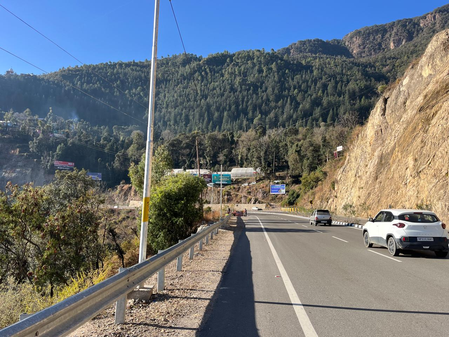
Shimla — The four-laning of the historic Kalka-Shimla highway via Parwanoo in Himachal Pradesh is approaching completion after more than a decade of construction, offering a smoother and faster journey through the hills. However, the modern upgrade has also led to the bypassing of several colonial-era landmarks that once defined the scenic route.
The expanded National Highway 5, which forms part of the historic Hindustan-Tibet Road, now features advanced infrastructure such as flyovers, viaducts, and tunnels, making travel more efficient. One major component still under construction is a tunnel near Kandaghat in Solan district, known for its bustling vegetable markets. The upcoming tunnel is expected to ease traffic congestion while preserving the town’s daily life and commercial activity.
The highway project faced repeated delays due to landslides and other challenges, but oversight from the Himachal Pradesh High Court helped accelerate progress. Officials confirm that the final construction phases, including the Kandaghat tunnel, are advancing steadily, bringing motorists closer to a seamless drive between the plains and Shimla.
Once completed, the highway will wind through pine forests, cross deep valleys via elevated flyovers, and pass through tunnels carved into mountainsides. Travellers will experience breathtaking views of deodar forests, mist-covered slopes, and historic stone bridges as they approach Shimla.
Originally upgraded to a national highway in the 1970s, the Parwanoo-Shimla route has long served as a major access point to the former summer capital of British India. The new alignment, however, bypasses towns such as Parwanoo, Kumarhatti, Barog, and Kandaghat, along with notable heritage attractions including railway crossings along the UNESCO-listed Kalka-Shimla narrow-gauge railway, local bazaars, and the Rani Jhansi statue at Chambaghat.
Construction on the four-laning project began on September 21, 2015, and was initially scheduled for completion by March 2018. Union Road Transport and Highways Minister Nitin Gadkari highlighted the construction of a 160-metre viaduct using hydraulic push-launching technology as a key engineering achievement of the project.
Currently, work continues on a 667-metre twin-tube tunnel and a 368-metre flyover at Kandaghat. The broader 88-kilometre four-lane stretch between Shimla and Parwanoo, designed to reduce travel distance by 17 kilometres, is largely complete.
Additionally, a 936-metre one-way tunnel on the Barog bypass is already operational. Built at a cost of Rs 100 crore, it shortens the route by 3.5 kilometres. Two overbridges over the heritage railway line at Sanwara and Chambaghat, along with a flyover at Kumarhatti, have collectively reduced travel distance by another three kilometres.
Motorists have welcomed the improved infrastructure. Neha Dubey, a traveller from New Delhi, described the developments as a positive step while noting the passing view of the historic Solan Brewery from a flyover. The brewery, established by Edward Dyer in 1855 near the Kasauli hills, remains an important colonial landmark. Her husband, Virain, remarked that travellers driving at higher speeds may now miss several historic sites, including the Solan distillery and the once-popular Chakki Mod near Kasauli.
Veteran travellers also recall the older zigzag mountain road lined with heritage railway tunnels, roadside food stalls, and popular photo spots that captured the charm of the region.
Historically, construction of the Hindustan-Tibet Road from Kalka to Shimla began in 1850 under British rule. Horse-drawn mail wagons started operating on the route in the 1860s, while motor vehicles were introduced by 1935.
According to the National Highways Authority of India (NHAI), the project gained momentum through digital monitoring under the PRAGATI initiative and coordination by the Project Monitoring Group, which helped resolve long-standing administrative and inter-governmental hurdles. The 39-kilometre Parwanoo-Solan section, built at a cost of Rs 1,635 crore, passes through 33 revenue villages and environmentally sensitive mountainous terrain.
The upgraded highway is expected to significantly enhance connectivity while preserving the legacy and natural beauty of the Himalayan region.
With inputs from IANS