
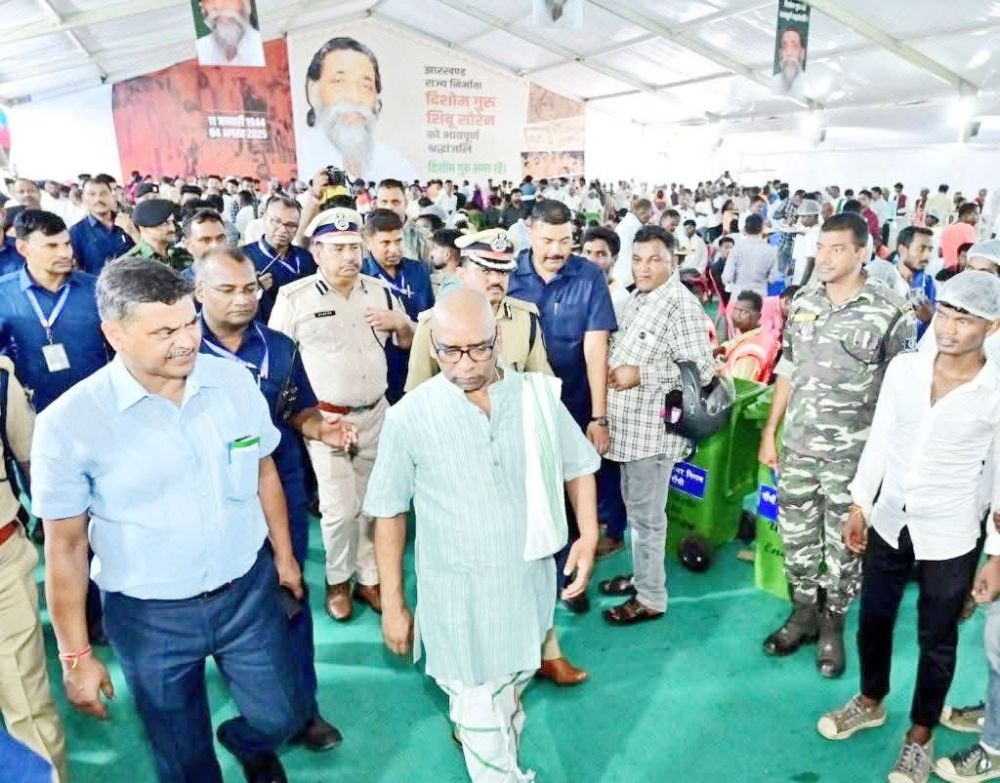
Nemra/Ranchi: The usually quiet Nemra village in Ramgarh district turned into a sea of sorrow and reverence on Saturday as lakhs of people converged for the shraddh ceremony of former chief minister and Jharkhand Mukti Morcha (JMM) supremo Shibu Soren, affectionately called Dishom Guru. The green fields and narrow mud tracks leading into the village echoed with chants of “Guruji Amar Rahe” as men, women, elders, children, and differently-abled devotees arrived in steady streams since morning, carrying flowers and folded hands to pay their last respects.
The atmosphere was deeply moving: lines of barefoot villagers walked alongside convoys of cars and buses carrying party workers and dignitaries, all heading towards the Sorens’ ancestral residence. Within sprawling pandals decorated with portraits of the late leader, visitors bowed their heads, some weeping silently, as they paused before his garlanded image. It was not just a political farewell but a community expressing gratitude to the man who symbolised the tribal struggle for dignity and self-rule.
Officials estimated that by late afternoon more than 1.5 lakh people had already reached Nemra, with the crowds continuing to swell. Many came on foot from nearby villages, crossing fields and forest trails. Organisers prepared for an unprecedented turnout, erecting five massive pandals equipped with coolers, air-conditioners, and seating for thousands.
To ensure uninterrupted power, over 200 generators were deployed. At least 300 e-rickshaws ferried visitors between the six designated parking sites and the event venue. Together, these parking arrangements accommodated over 8,000 vehicles, with separate facilities set up for VIP convoys.
“The arrangements are befitting of Guruji’s stature. He belonged to every home in Jharkhand, so today every home has come here,” said an emotional official overseeing the control room operations.
The ceremony drew leaders across the political spectrum, reflecting Shibu Soren’s stature as a unifying figure in Jharkhand and beyond. Union Defence Minister Rajnath Singh was among the earliest to pay tribute, laying flowers before Guruji’s portrait and describing him as “a leader who, after Birsa Munda, emerged as the tallest icon of India’s tribal communities.”
“As far as I have known him, Dishom Guru was a warrior for the poor. His simplicity and dedication deeply touched me. His loss is irreparable, and on behalf of the Union government and my party, I bow before his memory,” Singh said after meeting Chief Minister Hemant Soren and other family members.
From outside Jharkhand, Telangana Chief Minister A. Revanth Reddy also attended, hailing Soren as “a guiding force for all who struggle for justice and equality” and conveying his condolences to the bereaved family.
Other leaders who came to Nemra included former Union minister Ashwini Kumar Choubey, MP Pappu Yadav, former Rajya Sabha member R. K. Anand, and Minister of State for Defence Sanjay Seth. Yoga guru Baba Ramdev too offered his homage at the pandal, while Governor Santosh Gangwar praised Soren’s journey as “extraordinary, from grassroots agitations in Santhal Pargana to representing the marginalised in Parliament.”
Chief Minister Hemant Soren, visibly moved, has been camping in Nemra since August 5 to supervise preparations. On Saturday, alongside his family, Hemant received dignitaries and met the steady flow of mourners, thanking them for their support.
A special exhibition and memorial gallery was opened near the main pandal to narrate Shibu Soren’s remarkable life. Rare photographs from his youth, historic documents of the Jharkhand movement, and images from his parliamentary career were put on display. Visitors walked through the gallery in silence, pausing to read about his struggles against feudal exploitation in the coalfields and his role in the decades-long agitation for statehood.
Elderly villagers standing before one such photograph recalled his early days of mobilising tribal communities. “He was never just a politician. He was our guardian, our teacher, our Dishom Guru,” said a visitor from Dumka, tears in his eyes.
For the lakhs who travelled to Nemra, Saturday’s shraddh bhoj was more than a ritual meal—it was an intimate act of remembrance. Traditional food was served in endless cycles through the day as mourners sat under decorated canopies, sharing both sustenance and sorrow.
“Once, Guruji had a meal in our home in Santhal Pargana. Today, we feel like he is still feeding us, only this time through memory,” said a farmer from Pakur.
As twilight descended on Nemra, the chants grew softer but the crowd showed no sign of thinning. Organisers said the communal meal would likely continue late into the night, possibly until 2 or 3 am, such was the magnitude of participation.
In death, as in life, Shibu Soren united the disparate threads of Jharkhand’s identity—tribal and non-tribal, rich and poor, leaders and commoners. On Saturday, Nemra became more than just a village; it became a collective ground of mourning, remembrance, and resolve.
The palpable grief of the masses was tempered by the pride that one of their own had carved a place in India’s political history. As villagers slowly retraced their paths back through paddy fields and winding roads, one sentiment lingered in their words: Dishom Guru may be gone, but his ideals of justice, simplicity, and service will endure forever.