
New Delhi- The Union Ministry of Home Affairs (MHA) has rolled out PRAHAAR, India’s first comprehensive national counter-terrorism policy and strategy, marking a decisive shift in how the country confronts terrorism originating both within and beyond its borders.
The policy document outlines India’s zero-tolerance stance against terrorism and details a structured framework that consolidates past measures while clearly defining future operational strategies. It reflects a transition from reactive responses to a proactive, coordinated and institutionalised counter-terror doctrine.
For decades, India has endured repeated terrorist attacks orchestrated by cross-border networks, jihadist groups and their proxy organisations. Global terror outfits such as Al Qaeda and Islamic State of Iraq and Syria have attempted to establish sleeper cells within the country, exploiting gaps in intelligence coordination and jurisdictional boundaries.
Earlier responses largely relied on diplomatic protests, international dossiers and appeals to the global community. PRAHAAR, however, signals a break from this approach by emphasising direct action against terror networks, their handlers and logistical ecosystems, regardless of location.
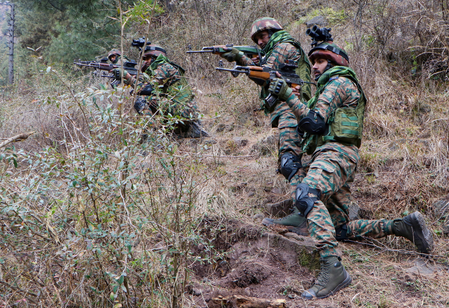
This strategic recalibration has already been reflected in recent counter-terror operations. In Jammu and Kashmir’s Kishtwar district, security forces eliminated a senior Jaish-e-Mohammad commander during a prolonged operation in hostile terrain. Simultaneously, in Tamil Nadu, authorities dismantled an ISI-backed sleeper cell linked to ISIS operatives, underscoring a nationwide, intelligence-led offensive against terror modules.
The Kishtwar operation showcased India’s evolved military capabilities, including real-time drone surveillance, specialised canine units and precise intelligence coordination. Security forces neutralised the terrorists without collateral damage, reinforcing the message that no sanctuary will be tolerated for terror operatives.
In Tiruppur, Tamil Nadu, the arrest of eight ISIS-linked operatives — most of them Bangladeshi nationals — exposed attempts to infiltrate labour-intensive industries using forged identities, with plans to carry out IED attacks in crowded areas. The success of the operation highlighted the effectiveness of integrated intelligence-sharing mechanisms such as the Multi-Agency Centre.
The eight-page PRAHAAR document, now available on the MHA portal, notes that India faces terrorist threats across land, air and maritime domains. It emphasises safeguarding critical infrastructure, including power, railways, aviation, ports, defence installations, space assets and atomic energy facilities, from both state and non-state actors.
Border guarding forces, central armed police units and immigration authorities have been equipped with advanced surveillance tools and technology to tighten border security and prevent infiltration.
At its core, PRAHAAR represents India’s first unified national counter-terrorism doctrine, built on seven foundational pillars:
- Proactive prevention: Intelligence-led identification and neutralisation of threats before execution
- Proportionate response: Freedom to deploy military and security responses without escalation paralysis
- Capacity aggregation: Standardisation of counter-terror mechanisms across states to eliminate jurisdictional loopholes
- Rule of law: Strong legal frameworks with high conviction rates while ensuring due process
- Targeting the ecosystem: Crackdown on terror financing networks and over-ground workers
- International alignment: Strengthening global cooperation through treaties and coordinated action
- Recovery and resilience: Promoting public-private partnerships for rapid post-incident recovery
By institutionalising these principles, PRAHAAR marks a clear departure from fragmented and defensive strategies, positioning India for sustained, proactive and decisive counter-terror operations in the years ahead.
With inputs from IANS