
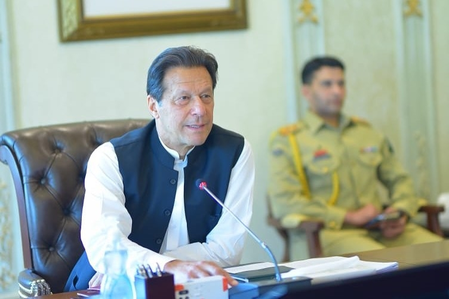
New Delhi: In what appears to be a recurring cycle shaped by political manoeuvring or military influence, no Prime Minister of Pakistan has ever completed a full term — a pattern now reflected in the dramatic downfall of former premier Imran Khan.
This fate is not unique to Khan. His predecessor, Shahid Khaqan Abbasi, was arrested in July 2019 under Imran Khan’s own government on charges related to a 2013 LNG import contract. His arrest, part of Khan’s aggressive “accountability drive”, was widely viewed as politically motivated persecution, despite the government presenting it as a crackdown on corruption.
Today, the script is being replayed with different actors.
Throughout Pakistan’s history, at least five former prime ministers — Zulfikar Ali Bhutto, Benazir Bhutto, Nawaz Sharif, Shahid Khaqan Abbasi, and now Imran Khan — have been jailed on a range of charges, from political murder and corruption to contempt and security violations. Outcomes have included execution, exile, disqualification, or recurring cycles of arrest and release.
This turbulent pattern has led many to call the office of Pakistan’s Prime Minister “one of the riskiest jobs in the world”.
Imran Khan: Isolation, Uncertainty, and Rising Public Anger
The current crisis is marked by Imran Khan’s alleged near-total isolation in prison, reportedly without access to visitors despite a court order permitting weekly meetings. Conflicting statements — officials denying rumours of his death while family members claim something “irreversible” may be being concealed — have only heightened public anxiety.
Pakistan has since moved to a high-security footing, imposing red alerts, sealing major roads, banning gatherings, and tightening control in Islamabad and Rawalpindi. The capital hosts the court overseeing Khan’s case, while the adjoining garrison city houses the prison where he is being held.
A Long History of Civil–Military Power Struggles
Pakistan’s political instability is deeply intertwined with military interventions:
- Zulfikar Ali Bhutto was arrested after General Zia-ul-Haq’s 1977 coup.
- Nawaz Sharif was ousted and jailed following General Pervez Musharraf’s 1999 takeover.
- Imran Khan, many argue, is now facing the consequences of his confrontation with the current army chief General Asim Munir.
While Prime Minister Shehbaz Sharif has worked closely with the military establishment, Imran Khan openly challenged its authority — first hinting at influence over generals, and later criticising the army leadership directly. His supporters’ attacks on military installations in 2023 marked a point of no return.
Ethnic Tensions Add a Dangerous Layer
Khan’s rivalry with General Asim Munir also reflects the ethnic complexities of Pakistan’s politics. The military has long been dominated by Punjabis, while many of Khan’s supporters — particularly Pashtuns and urban middle-class groups — see him as a symbol of resistance against Punjabi-dominated establishment rule.
Munir was removed as ISI chief in 2019 under Khan’s government, deepening the personal and institutional conflict. Many of Khan’s backers view his current troubles as a continuation of the military’s historical marginalisation of Pashtun leadership.
A Familiar Crisis, A Fragile Nation
With political tensions soaring and the economy under severe strain, Pakistan once again finds itself confronting a familiar and combustible question: Why do elected prime ministers repeatedly fall at the hands of military power?
As history appears poised to repeat itself, Pakistan is left grappling with deepening mistrust, ethnic divides, and the lingering spectre of military dominance over civilian leadership.
With inputs from IANS