
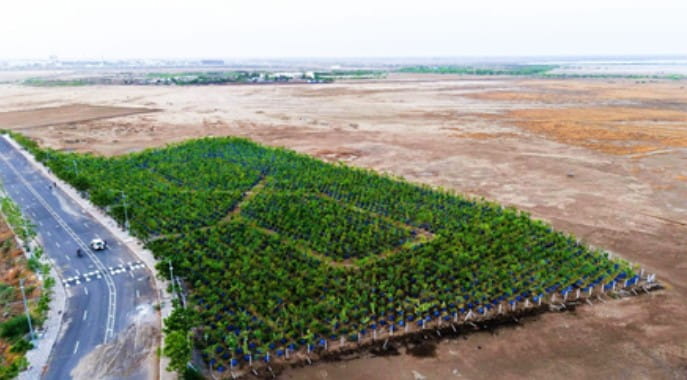
Gandhinagar: A pioneering afforestation initiative in Gujarat’s Dholera region has demonstrated remarkable success in converting highly saline and waterlogged land into a thriving green zone. More than 3,200 saplings planted using an innovative “drum plantation” technique have survived, with several growing up to 12 feet tall within a year, prompting authorities to expand the project across an additional 20 hectares.
The pilot project was carried out in Block No. 29 of the Activation Area of the Dholera Special Investment Region (SIR) in Ahmedabad district, with financial support from the Dholera Special Investment Region Development Authority (DSIRDA).
According to the Forest Department, the initiative was designed to overcome the severe environmental challenges of the region, where high soil salinity, poor carbon content, and prolonged waterlogging have traditionally made tree growth extremely difficult. In many areas, stagnant water remains for up to six months annually, causing conventional plantation efforts to fail.
The saplings were planted in August 2025 using a technique developed by the Ahmedabad Social Forestry Division. Under this method, young plants are placed inside perforated plastic drums filled with a specially prepared mixture of sand, fertile soil, vermicompost, cocopeat, and dry grass. The drums are partially buried in the ground, allowing roots to remain above the most saline soil layers while ensuring proper aeration and drainage.
Dr. Meenal Jani, Deputy Conservator of Forests, Ahmedabad Social Forestry Division, said the approach was specifically designed to tackle the area’s harsh conditions.
She explained that the soil’s high salinity and electrical conductivity, combined with long periods of water stagnation, made plant growth nearly impossible. The drum plantation system created a controlled growing environment that significantly improved survival rates.
A drip irrigation network has been installed throughout the plantation area, with DSIRDA supplying saline water for irrigation. Despite these challenging conditions, the saplings have shown impressive growth, with many reaching heights of up to 12 feet in less than a year.
Officials also reported that some tree species have already started flowering and bearing fruit, encouraging the return of pollinating insects, butterflies, and birds. In addition, naturally regenerating grasses have begun appearing in parts of the plantation, indicating the gradual restoration of ecological activity.
The plantation includes more than 15 tree species, such as neem, banyan, peepal, arjun, tamarind, pongamia, and palash, selected for their adaptability and ecological value.
To ensure environmental sustainability, authorities plan to remove and recycle the plastic drums in future stages of the project once the trees are firmly established.
Encouraged by the success of the pilot, DSIRDA has approved the expansion of the initiative to another 20 hectares, with plans to plant more than 50,000 saplings in the next phase.
The project is part of broader efforts to balance environmental conservation with industrial growth in Dholera, which is being developed as one of Gujarat’s major industrial and infrastructure hubs. The success of the drum plantation model could also offer a replicable solution for afforestation in other saline and degraded landscapes across India.
With inputs from IANS