
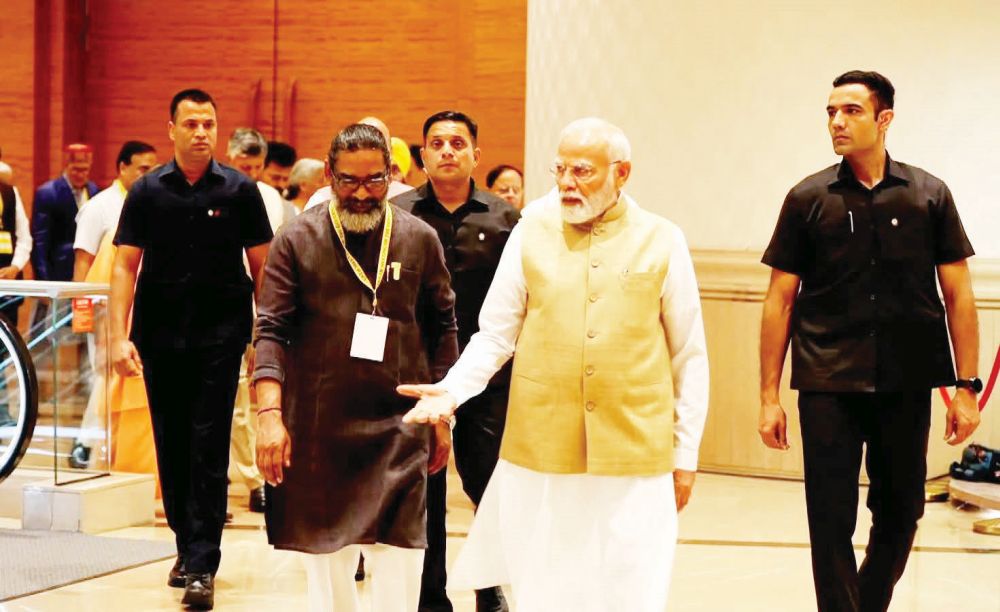
New Delhi/Ranchi: Chief Minister Hemant Soren attended the 10th Governing Council meeting of the NITI Aayog in New Delhi on Saturday. The meeting, chaired by Prime Minister Narendra Modi, saw participation from Union Home Minister Amit Shah, NITI Aayog Chairman Amitabh Kant, and several Chief Ministers, Governors, and senior officials from across the country. Representing Jharkhand, CM Soren put forward key demands and recommendations to ensure the state’s inclusive development and highlighted region-specific challenges that need immediate central attention.
Soren said the vision of a developed India cannot be realised without developing the states, and that developing rural India—especially villages—should be central to this vision. He said Jharkhand continues to make consistent efforts towards poverty elimination, women’s empowerment, skill development for youth, farmers’ upliftment, full literacy, economic growth, infrastructure development and technological progress. During his address, he brought to the Prime Minister’s attention the specific needs of the people of Jharkhand.
The Chief Minister strongly advocated for amending the Coal Bearing Areas (CBA) Act to include a provision mandating companies to return acquired land to the state after mining is complete. He pointed out that mining operations across Jharkhand had led to widespread pollution and displacement, and that companies owe the state over Rs 1.40 lakh crore in unpaid land compensation. Soren also demanded accountability for unauthorised mining and proposed the mandatory installation of captive plants by mining companies, with at least 30% of total production to be utilised within the state to boost employment. He highlighted the state’s rich coal-based methane reserves and called for their use in energy generation.
Soren urged the central government to integrate companies’ CSR and DMFT funds with state-level development priorities. He called for an expansion of railway services in Jharkhand and presented Sahibganj district as a potential cargo hub that could also benefit neighbouring states. He also suggested building an additional bridge or dam on the Ganga River in Sahibganj. Emphasising the need to bridge regional imbalances, he said infrastructure must be expanded in strategically important areas. A dedicated industrial and mining corridor would streamline operations and bring significant economic benefits to the state.
The Chief Minister said schemes run by the Centre should be adapted to suit the conditions and needs of individual states. He informed the NITI Aayog that the Jharkhand government is already running multiple social security schemes like universal pension, Maiyan Samman Yojana, and Abua Swasthya Yojana. He recommended modifying central schemes to reflect ground realities and better serve the people. He said the state is providing 5 kg of rice per month to 25 lakh families, offering Rs 5 lakh health insurance to 28 lakh families excluded from the Ayushman Bharat scheme, and up to Rs 15 lakh insurance to 38 lakh poor families not covered under PMJAY. The government is also preparing district-wise health profiles and he recommended this approach be adopted nationally to strengthen healthcare services at block, subdivision and district levels.
Soren drew attention to the delays caused by forest clearance regulations due to Jharkhand’s high forest cover and requested that the state be granted the same special assistance provided to northeastern states. He also said that issues under the CNT and SPT Acts are affecting industrial development and need urgent coordination with the Finance Ministry.
On the issue of revenue sharing, he demanded that the share of states in the divisible tax pool be raised from 41% to 50%. He criticised the exclusion of cesses and surcharges from the divisible pool, which limits the states’ revenue share. He pointed out that after the implementation of GST in 2017, manufacturing states like Jharkhand have suffered significant revenue loss. While compensation was given for the first five years, the Centre has not released any such funds since June 2022, resulting in a severe fiscal hit to the state.
The Chief Minister also raised concerns over central security forces’ deployment charges being borne by the state, which he argued should be fully waived under cooperative federalism. On Left-Wing Extremism, he noted that the number of affected districts has reduced from 16 to just 2—West Singhbhum and Latehar—but said special central assistance should continue for all 16 former LWE districts to ensure long-term stability.
Soren also spoke about the welfare of migrant labourers, recalling how the state brought back stranded workers from Cameroon at its own expense. He appealed for central involvement in visa, security, and travel costs for Indian workers employed abroad. Concluding his address, he said that achieving the goals of ‘Viksit Bharat @2047’ is not possible without supporting states like Jharkhand. With greater cooperation and resources from the Centre, he said, the dream of a developed Jharkhand and a developed India can truly become a reality.
Chief Secretary Alka Tiwari, Additional Chief Secretary to CM Avinash Kumar, Resident Commissioner Arva Rajkamal, and Planning Secretary Mukesh Kumar were also part of the delegation from Jharkhand at the meeting.