
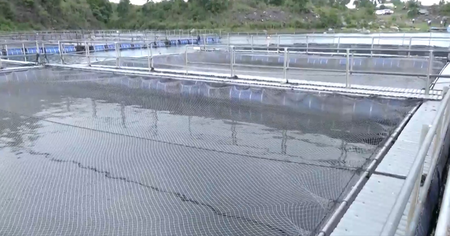
Ramgarh — Once deserted and waterlogged, the abandoned coal mines of Ramgarh district in Jharkhand have found new life as flourishing fish farms, providing employment and steady income to locals under the Pradhan Mantri Matsya Sampada Yojana (PMMSY).
Speaking to IANS, Arup Kumar Choudhary, District Fisheries Officer of Ramgarh, explained, “These abandoned coal mines had been lying idle for years, filled with stagnant water. But with the introduction of cage culture — initially limited to reservoirs — residents saw a new opportunity for livelihood through fish farming. Many locals approached us requesting to install fish cages in these mines to kickstart employment.”
Choudhary noted that several residents already had experience in fish farming. In 2013-14, a pilot project funded by the government set up a cage battery in one of the defunct mines to test the feasibility of fish cultivation.
“The technique that was successful in reservoirs was replicated in these abandoned mines — and it worked. Encouraged by the success, the state government granted full permission to expand fish farming operations in these sites,” Choudhary added.
With support from district and state authorities, as well as specific schemes from the Jharkhand government, many local families have taken up cage fish farming in these waterlogged mines.
The fish produced here is sold not only within Jharkhand but also supplied to nearby districts in Bihar, including Gaya and Sasaram.
“These projects have become a reliable source of income and have created jobs in fish production, transport, and marketing,” Choudhary said.
One of the success stories comes from Shashikant Mahato of Aara Basti village in Ramgarh, who has been actively involved in cage fish farming under the PMMSY scheme.
“This coal mine was shut down in 1999 and lay unused for years. In 2010, we took the initiative to release fish seed using our own funds, and the results were remarkable — we harvested nearly 27 quintals of fish,” Mahato recalled.
Encouraged by the outcome, they began cage fish farming in 2012, starting with 68 cages in one mine. Now, a second mine has been activated, employing around 20 people. Overall, nearly 100 families in Aara Basti village are now earning a livelihood through fish farming.
“Our village has about 250 households, and more than 100 of them are directly benefiting from this project,” Mahato added.
He explained how the initiative is steadily expanding. “Every year, four to six more families join in. I believe that soon, almost every household in our village will be connected to the fisheries department through this programme.”
With government support, they have also acquired an insulated van to transport fish, improving marketing efficiency and product freshness.
“We currently produce 40 to 60 tonnes of fish annually. Each family earns around Rs 1.5 to 2 lakh a year. Thanks to the Pradhan Mantri Matsya Sampada Yojana, our operations have become more organized, and even the younger generation is showing interest in the fisheries sector,” Mahato said proudly.
The revival of abandoned coal mines as productive fish farms is not only transforming the local economy but also serving as a model for sustainable livelihood development in resource-depleted areas.
With inputs from IANS