
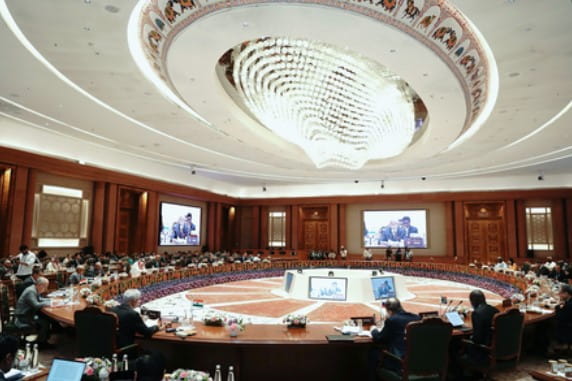
Moscow,- The recent BRICS Foreign Ministers’ Meeting held in New Delhi under India’s 2026 chairmanship managed to keep the bloc’s core agenda on track despite rising geopolitical tensions linked to the ongoing Gulf conflict, according to a report by Politeia Research Foundation.
The report noted that while the grouping successfully navigated a challenging diplomatic environment, the bigger test still lies ahead, making “quiet and smart diplomacy” crucial for the success of the upcoming BRICS summit in Delhi.
Following the May 14–15 meeting, BRICS members decided against issuing a joint statement and instead released a “Chair’s Statement and Outcome Document.”
India’s BRICS Sherpa and Secretary in the Ministry of External Affairs, Sudhakar Dalela, said the document reflected the common position of member nations on nearly all major issues.
The report observed that a detailed reading of the 63-paragraph document showed that despite differences among members over the Gulf conflict, BRICS continued to make progress on strengthening the grouping and advancing its broader objectives.
It added that predictions about the decline or weakening of BRICS appeared premature.
The meeting had been closely watched amid expectations of sharp exchanges between representatives of Iran and the United Arab Emirates over the ongoing hostilities involving Israel and the United States.
As chair of the bloc, External Affairs Minister S. Jaishankar acknowledged that member countries held differing views regarding the situation in West Asia and the Middle East.
According to the report, most participating nations called for resolving the conflict through dialogue and diplomacy while stressing the importance of sovereignty and territorial integrity. There was also broad agreement on safeguarding maritime trade routes and protecting civilian lives and infrastructure.
Beyond the Middle East crisis, the report said the foreign ministers discussed a wide range of proposals aimed at strengthening cooperation ahead of the next BRICS summit, expected to be held in Delhi in September this year, following the 2025 summit in Rio de Janeiro.
The report further highlighted that the final outcome document reflected several of India’s priorities, including stronger language on UN Security Council reforms, disaster management, food security, Digital Public Infrastructure (DPI), and counter-terrorism cooperation.
With inputs from IANS