
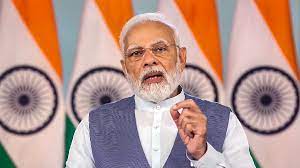
New Delhi: Principles such as non-aggression, synthesis, and the unity of all existence—rooted in ancient Indian philosophy—continue to shape India’s global posture in the contemporary world.
Independent India began its journey with the credo of “friendship for all, malice towards none.” Decades later, Prime Minister Narendra Modi reaffirmed this civilisational ethos at the G20 Summit in New Delhi in September 2023 through the mantra Vasudhaiva Kutumbakam—“one earth, one family, one future.” This articulation struck at the core of India’s strategic culture, which has consistently advocated peaceful coexistence rather than pacifism. At the same time, the Modi government has made it clear that India’s commitment to peace is underpinned by credible self-defence, built on the principle of self-reliance at a scale sufficient to deter adversaries.
Concurrently, India has pursued a strategy of cultivating bilateral relationships to advance mutual security and economic interests, working towards peaceful resolution of conflicts and championing humanitarian causes wherever suffering exists. In a multipolar world, India believes it can play a major role in promoting global peace without being constrained by rigid alliances. This calibrated approach to international relations has served India well.
The effectiveness of India’s diplomacy is reflected, in part, in the recently released US National Security Strategy unveiled by President Donald Trump on December 5. While the document prioritises “America First” objectives, it accords special importance to the Indo-Pacific region and explicitly recognises India’s role as a key partner in regional security through the Quad framework. The Quad appears to be gaining prominence as a strategic grouping aimed at balancing China’s rise.
On Pakistan, despite President Trump’s personal outreach to its leadership, the country figures marginally in the US strategy—primarily in the context of Trump’s reiterated claim that he played a role in easing tensions during the India-Pakistan military standoff in May. While India did not endorse this narrative, its standing as a major power committed to peace and development could not be ignored. Known for his transactional approach, Trump is closely monitoring Indo-US negotiations on trade and tariffs. India’s position remains consistent: competition should not escalate into confrontation. Its policy of pragmatic bilateralism, guided by national security and economic interests, extends to the United States as well and reinforces India’s strategic autonomy.
Even as Indo-US relations fluctuate between cordiality and hard-headed pragmatism during Trump’s second term, Russian President Vladimir Putin’s visit to India for the India-Russia Summit has contributed to restoring geopolitical balance from India’s perspective. The visit took place amid US pressure on India to reduce oil imports from Russia, citing concerns over Moscow’s military capabilities in the Ukraine conflict.
Prime Minister Modi described India-Russia ties as steadfast as a “guiding star,” while President Putin underscored the partnership in trade, investment, and technology. Putin assured uninterrupted energy supplies to fuel India’s rapidly growing economy and implicitly urged New Delhi to withstand US tariff pressures.
On the Ukraine-Russia conflict, Putin indicated that Moscow was exploring pathways to peace with the help of mediators, including the United States. His apparent personal equation with Trump contrasts with Washington’s pressure on Ukrainian President Volodymyr Zelensky to accommodate Russia on territorial issues. While economic cooperation was described by India’s Foreign Secretary as the “driving impulse” of Putin’s visit, the summit yielded broader dividends by enhancing geopolitical stability and international equilibrium—an outcome of particular significance for India.
India’s long-standing policy of avoiding alignment with any single superpower, while nurturing bilateral friendships, has strengthened its credentials as a leading advocate of global peace and development. It has enabled India to champion the interests of the Global South across platforms such as ASEAN and to play a constructive role in addressing conflicts—from the Ukraine war to the Gaza crisis following the October 7 Hamas attack.
At the same time, India remains acutely aware of threats posed by adversaries. Pakistan’s continued patronage of faith-based terrorism and China’s strategic partnership with Islamabad—clearly evident during the post-Pahalgam India-Pakistan confrontation—are matters of serious concern. India remains active in groupings such as BRICS and the SCO, while also upgrading its engagement with the Quad to counter Chinese assertiveness in the Indo-Pacific and uphold a rules-based regional order. New Delhi is equally vigilant about any Chinese expansion into the Indian Ocean region.
Under the Modi government, India has pursued economic and military self-reliance consistent with its doctrine of strategic autonomy and positive non-alignment. It has shown patience and flexibility in dealing with the United States, while maintaining the belief that the world’s two largest democracies are natural partners.
The current geopolitical landscape bears signs of a renewed Cold War dynamic. A resurgent China is positioning itself as a potential second superpower through rapid economic, technological, and military expansion, with Russia increasingly playing a subordinate role. In regions such as Iran and Afghanistan, US interests appear to be countered by a China-Russia alignment. Competition between Washington and Beijing in the Global South, combined with President Trump’s revival of a Monroe Doctrine–style outlook—viewing the Western Hemisphere as an exclusive US sphere of influence under the MAGA agenda—has further deepened bipolar tendencies in global politics.
Trump’s scepticism towards NATO, the European Union, and multilateral aid initiatives—dismissed by his administration as wasteful—reflects a broader retreat from traditional international commitments. His tilt towards Russia in the Ukraine conflict is shaped partly by personal rapport with President Putin. Despite these shifts and ongoing tariff pressures, India has demonstrated its ability to maintain balanced relations with both Washington and Moscow.
India has remained firm in its position that “this is not an era of wars,” as articulated by Prime Minister Modi at the outset of the Ukraine conflict, while retaining the freedom to plan countermeasures against an assertive China. A key contemporary challenge lies in the Trump administration’s renewed engagement with Pakistan for trade-related reasons, overlooking Islamabad’s role in fostering terrorism at a time when China continues to collude with Pakistan against India. Addressing the strategic threat posed by the Sino-Pak axis has therefore become a central priority in India’s national security calculus.
(The writer is a former Director, Intelligence Bureau)