
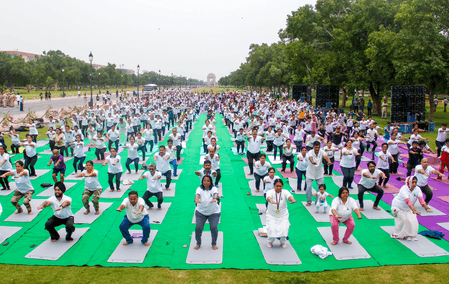
As the yoga mats are packed away and social media fills with International Yoga Day photographs, one thing becomes increasingly clear—Indian politicians hardly need formal yoga lessons. For years, many of them have been perfecting political postures that require far more flexibility, balance and endurance than any traditional asana.
In many ways, Indian politics resembles a giant yoga studio, where every party has developed its own signature pose.
The ruling BJP has perfected what could be called the Victory Asana. It is a demanding posture that requires unwavering confidence regardless of the political situation. A string of electoral successes has helped the party establish a formidable national presence, and sustaining that confidence after more than a decade in power is no small feat. Its latest triumph in West Bengal showcased what could be described as Precision Yoga—a carefully choreographed sequence of political moves executed with remarkable discipline.
Like any difficult pose, however, even the ruling party occasionally loses balance. The recent Karnataka MLC elections, where some legislators cross-voted, served as a reminder that perfection is never guaranteed.
The Opposition, meanwhile, excels in an entirely different discipline—the Perpetual Protest Pose. The principle is straightforward: oppose every government decision. If the government moves in one direction, object. If it changes course, object again. Even standing still becomes grounds for criticism.
No one embodies this style more consistently than Rahul Gandhi, who has become the foremost practitioner of the Eternal Discontent Asana.
For years, Gandhi has maintained a posture of constant criticism irrespective of political circumstances. Government achievements are questioned, policy reversals are criticised, and periods of inaction are portrayed as failure. In this form of political yoga, satisfaction is never the destination; continuous dissent is.
Alongside this, he must convince the country that he remains the natural challenger to Prime Minister Narendra Modi, reassure Congress workers that electoral success is within reach, and persuade alliance partners that he deserves to lead the Opposition. Balancing all these expectations requires considerable political flexibility.
Several other Opposition leaders perform variations of similar routines.
Akhilesh Yadav has mastered the Coalition Stretch Asana, where political flexibility reaches extraordinary levels. Yesterday’s rival can become today’s ally, while today’s ally may become tomorrow’s bargaining partner. Coalition politics constantly tests ideological elasticity.
Arvind Kejriwal once specialised in the Rapid Motion Asana, appearing to campaign, govern, protest and debate simultaneously. Following recent electoral setbacks, however, he seems to have shifted to Strategic Meditation—remaining politically relevant through greater restraint and fewer public interventions. Anyone familiar with meditation knows that silence can often be the toughest discipline.
Mamata Banerjee, meanwhile, finds herself practising the Defiant Reality Asana. For years, she projected political invincibility in West Bengal, surviving every challenge that came her way. But 2026 brought an unexpected reversal as her government lost power and she herself was defeated in her constituency.
Politics, much like yoga, has a habit of testing those who become too comfortable in a particular position. Banerjee’s immediate challenge is no longer defeating her opponents but restoring confidence among supporters who had almost forgotten what electoral defeat felt like.
Her INDIA bloc colleague Uddhav Thackeray has become the leading practitioner of the Shrinking Circle Asana. It is a difficult pose in which leaders continue to claim ownership of a political legacy even as colleagues, legislators, symbols and organisational strength gradually drift away.
Since the split in the Shiv Sena, Thackeray’s political journey has largely been about regaining balance after repeated setbacks. Despite losing his government, party symbol and many senior leaders, he continues to assert that he alone represents the party’s original ideology.
Collectively, however, the Opposition’s most recognisable exercise remains the INDIA Bloc Pranayama. It begins with a deep breath of unity, followed by holding that breath through prolonged seat-sharing negotiations. Once disagreements inevitably surface, the air is released, only for the entire cycle to begin again before the next election.
The ruling alliance has developed its own breathing technique—inhale electoral victories and exhale confidence, often in generous doses. Occasionally, the confidence becomes so abundant that discussions begin about elections that are still years away.
Perhaps the most fascinating aspect of Indian politics is that every party believes it is following a unique philosophy, even though their political movements often look remarkably similar.
Amid all these carefully practised postures, one group remains the true master of political yoga—the voters.
Every election reminds politicians that the ultimate balancing act lies not with leaders but with the electorate. Through what may be called the Voter Asana, ordinary citizens possess the unique ability to unseat even the most powerful governments.
In the end, it is the voter alone who knows when to pull the mat from beneath a seasoned politician’s feet.
With inputs from IANS