
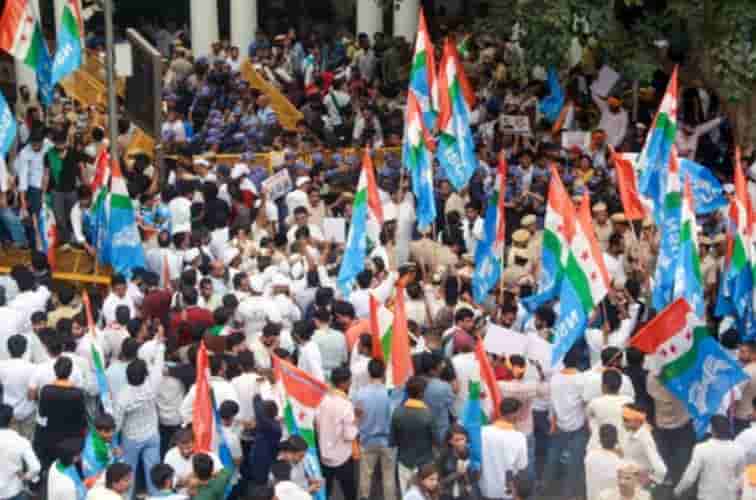
New Delhi- The Opposition’s escalating campaign against Chief Election Commissioner Gyanesh Kumar over alleged irregularities in electoral roll revisions has brought a familiar question back into focus: how can the right to protest be protected without imposing an undue burden on ordinary citizens?
Opposition parties have alleged that the revision exercise contains irregularities and disproportionately benefits the ruling Bharatiya Janata Party (BJP). The agitation has spread to several cities, bringing Opposition leaders, activists, student organisations and the Cockroach Janta Party (CJP) onto the streets.
In a parliamentary democracy, citizens and political parties have the right to protest against government policies, public institutions and administrative decisions. Supporters of the demonstrations argue that questioning the conduct of elections is not merely a political exercise but an essential part of democratic accountability.
India’s democratic history offers numerous examples of public movements, civil society campaigns, parliamentary resistance and judicial intervention contributing to institutional change. The right to dissent is therefore central to democratic life, allowing citizens to challenge decisions they consider unjust or arbitrary.
The debate becomes more complicated, however, when demonstrations affect the daily lives of people who have no direct connection with the dispute.
As the agitation has intensified, authorities have stepped up security arrangements. Earlier demonstrations in central Delhi led to the closure of several major Metro stations, including Rajiv Chowk, Central Secretariat, Janpath and New Delhi. Traffic restrictions and barricades also disrupted movement across parts of the capital.
Ahead of the anticipated demonstrations on Friday and Saturday, the Delhi Police proposed heightened restrictions, including the closure of entry and exit gates at 57 Metro stations from Friday night. The proposal cited concerns over crowd mobilisation and attempts to enter high-security zones. Reduced train frequency at affected stations was also proposed.
The Railways, meanwhile, announced precautionary train cancellations amid concerns about possible congestion or disruptions around railway hubs in the capital.
Authorities have pointed to earlier incidents in which large numbers of passengers reportedly faced difficulties reaching railway stations because of road blockades and overcrowding. For daily commuters, such disruptions can mean missed trains, delayed appointments, lost working hours and additional travel costs.
Protest organisers and supporters offer a different perspective. They argue that peaceful petitions, memoranda and symbolic demonstrations often fail to elicit a meaningful response from those in power. In some cases, they contend, even protests at designated venues face restrictions, leaving demonstrators with few effective ways to draw public attention to their grievances.
From this standpoint, disruption becomes a means of forcing authorities to engage with issues they might otherwise ignore. There is a political logic to the argument: demonstrations that attract attention can increase pressure on decision-makers. But that does not automatically make every form of disruption justified.
The right to assemble peacefully and express dissent must be balanced with the rights of fellow citizens. Freedom of expression does not remove the responsibility to consider how a protest affects others, particularly those who depend on public transport or have limited alternatives.
The consequences are not always caused directly by demonstrators. Security agencies may impose closures, barricades and transport restrictions as precautionary measures. Yet, whatever the immediate cause, the burden often falls on ordinary people who have little influence over the dispute.
This creates a difficult balance. Authorities should not use public inconvenience as a blanket justification for suppressing peaceful demonstrations, nor should they impose sweeping restrictions without assessing whether less disruptive security measures are possible. At the same time, protest organisers must consider how to sustain public support without placing disproportionate costs on commuters, workers, students and patients.
Designated protest venues, negotiated routes, advance coordination with transport authorities and clearly communicated traffic plans can help reduce disruption while preserving the visibility of demonstrations. Such arrangements require cooperation from both the administration and protest organisers.
As the confrontation over the Election Commission continues, the political debate is likely to remain intense. The answer is not to choose between democratic dissent and public convenience as though one must come at the expense of the other.
A healthy democracy must protect the right to question institutions and demand accountability. It must also ensure that citizens can carry on with their daily lives as far as reasonably possible. The real test lies in finding ways for both rights to coexist without either becoming a pretext to undermine the other.
–IANS