
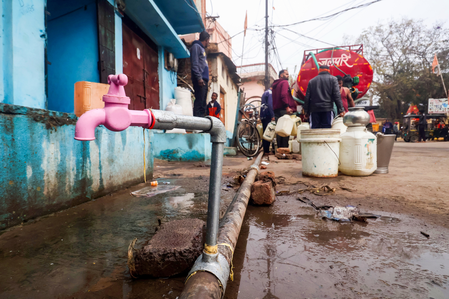
New Delhi: Nearly one-fifth of India’s rural households are still without tap water connections, with Kerala and Jharkhand topping the list of states where the highest proportion of village homes remain unconnected, the government told Parliament on Thursday.
Responding to a query in the Lok Sabha, Minister of State for Jal Shakti V. Somanna said that about 3.54 crore rural households — roughly 18.29 per cent of the total — are yet to receive piped drinking water.
The data revealed that Kerala has the highest share, with 45.12 per cent of its rural households still waiting for tap water supply. Jharkhand follows closely, where 44.82 per cent of village homes remain without the facility.
In absolute numbers, about 31.93 lakh rural households in Kerala and 28.03 lakh in Jharkhand are yet to be connected to the piped water network.
The government highlighted the progress made under the Jal Jeevan Mission, launched in 2019 with the aim of providing tap water to every rural household.
At the time the mission began, only 3.23 crore rural households — around 16.7 per cent of the total — had access to tap water. Since then, over 12.58 crore additional households have been connected.
As of March 3, 2026, out of nearly 19.36 crore rural households in India, around 15.82 crore — or 81.71 per cent — now have tap water supply, while work is ongoing to cover the remaining households.
The minister said that 11 states and Union Territories have already achieved 100 per cent coverage under the programme. These include Gujarat, Haryana, Himachal Pradesh, Punjab, Rajasthan, Tripura, Nagaland, Goa, Dadra and Nagar Haveli and Daman and Diu, Arunachal Pradesh, and the Andaman and Nicobar Islands.
Under the scheme, drinking water quality must comply with the Bureau of Indian Standards’ BIS:10500 norms. States and UTs can allocate up to two per cent of their annual funds for monitoring and surveillance activities related to water quality.
This includes establishing testing laboratories, purchasing equipment and chemicals, hiring trained personnel, and promoting community participation in water testing through field test kits.
To strengthen monitoring practices, the government released a handbook in December 2024 outlining guidelines for testing water quality at different stages — from the source and treatment plant to storage and distribution systems.
The ministry also conducts periodic functionality assessments through independent third-party agencies.
The 2024 assessment found that most surveyed villages had tap water connections, with 98.1 per cent of households reporting access. Among these, 87 per cent had received water during the previous week, 84 per cent said supply was regular, and 80 per cent were receiving at least 55 litres per capita per day.
The study further showed that the majority of water supplies met quality standards, with 76 per cent free from bacteriological contamination and 81 per cent of sources free from chemical contamination. Overall, 76 per cent of the household tap connections were found to be functioning properly.
With inputs from IANS