
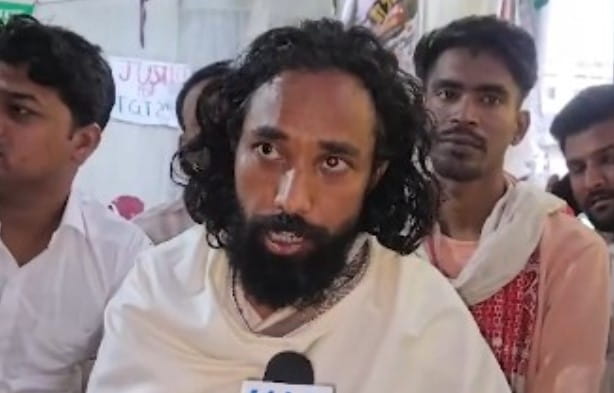
Ranchi: Jharkhand student leader Devendra Nath Mahto has said that political parties must engage with young people, but such interactions should not remain confined to discussions and promises. He stressed that today’s youth are looking for concrete solutions to issues such as unemployment, examination paper leaks and irregularities in government recruitment.
Mahto, who has previously led protests over alleged irregularities in recruitment examinations in Jharkhand, said a fresh agitation for reforms in the state’s recruitment system would begin on Monday.
The earlier protest was withdrawn after the Jharkhand government, led by the Jharkhand Mukti Morcha, cancelled the 11th and 13th Jharkhand Public Service Commission examinations and the appointments made through them. However, the High Court later stayed the government’s decision, leaving the issue unresolved.
Speaking to IANS, Mahto said the new protest would begin from Nemra village in Ramgarh district, the paternal village of former Jharkhand Chief Minister and late JMM patriarch Shibu Soren.
“Our only goal is justice. We need strong steps. We are no longer going to stop merely on assurances and dialogue,” Mahto said.
His remarks came in the backdrop of the Bharatiya Janata Party’s initiative to reach out to Gen Z through a dedicated committee. While welcoming the move, Mahto said political outreach would have meaning only if it resulted in solutions.
“Dialogue is welcome, but today’s youth do not want only dialogue and questions. They want concrete solutions. They want an assurance through dialogue that their future will not be played with,” he said.
Mahto said the concerns of young people extend beyond Jharkhand and include unemployment and the recurring problem of paper leaks in competitive examinations across the country.
“Dialogue should not be limited to political discussions. It should lead to a decision and should not merely become a slogan,” he said, adding that attempts to contain public anger through talks without addressing the underlying problems would not work.
He also argued that recent youth protests cannot be viewed through the traditional political lens. Referring to demonstrations in Delhi and Jharkhand, Mahto said young protesters were not necessarily supporting or opposing any particular political party.
“Today’s youth are struggling for their future and for reforming a system that has become rotten,” he said, pointing out that protests have taken place in both BJP-ruled and non-BJP-ruled states.
According to Mahto, this also makes it difficult to attribute such movements to the influence or direction of any ruling party or Opposition group.
Reacting to FIRs registered against 14 identified students and others in connection with the protests, Mahto accused the state government of adopting what he described as a “dictatorial attitude”. At the same time, he acknowledged that the protesters were aware of the risks before joining the movement.
“We knew even before leaving our homes that fighting this system would not be easy,” he said.
Mahto said arrests, police action, allegations and even physical force were among the challenges protesters expected to face while pursuing their demands.
Drawing parallels with the struggles of freedom fighters and social reformers such as Birsa Munda, Bhagat Singh, Subhas Chandra Bose, Mahatma Gandhi and B.R. Ambedkar, he said the protesters would continue to rely on constitutional and legal avenues.
“Let the government and administration do their work according to law and order. We have faith in the Judiciary and the Constitution,” Mahto said.
The fresh agitation is likely to keep the issue of recruitment reforms and the concerns of job-seeking youth at the centre of political and administrative attention in Jharkhand.
With inputs from IANS