
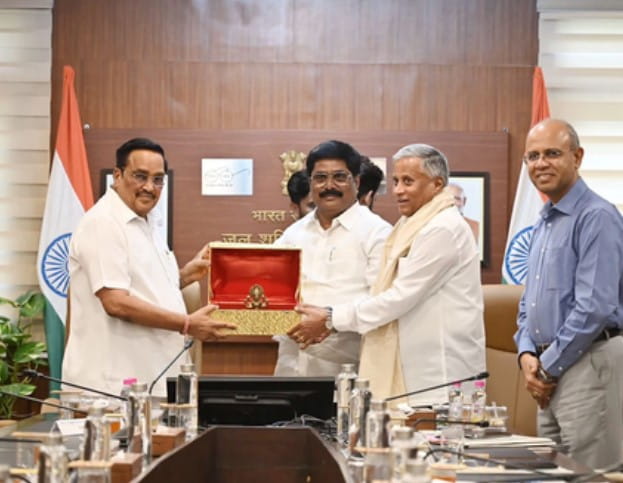
Ranchi/New Delhi: The Jharkhand government on Tuesday signed a Memorandum of Understanding (MoU) with the Centre under the second phase of the Jal Jeevan Mission, aimed at ensuring tap water connectivity to every rural household in the state.
The agreement was signed in New Delhi between the Union Ministry of Jal Shakti and the Jharkhand government in the presence of C. R. Patil, Jharkhand Drinking Water and Sanitation Minister Yogendra Prasad, and senior officials from both governments. Chief Minister Hemant Soren joined the event through video conferencing.
During the programme, Soren urged the Centre to release approximately ₹6,500 crore in pending funds under the Jal Jeevan Mission. He said that since 2019-20, drinking water projects worth ₹24,635 crore have been undertaken across Jharkhand under the scheme, covering both multi-village and single-village water supply projects.
According to the Chief Minister, nearly 55 per cent of the projects have been completed, while the state has so far received only 46 per cent of the sanctioned central assistance. He also pointed out that adequate funds were not released during the financial years 2024-25 and 2025-26, affecting the pace of implementation.
Emphasising the importance of timely financial support, Soren said uninterrupted funding is essential for completing the remaining projects on schedule. He also highlighted delays in obtaining no-objection certificates (NOCs) from various central agencies, which, he said, are slowing down the execution of several drinking water schemes. He appealed to the Centre to expedite the approval process.
The Chief Minister further noted that the state has appointed “Jal Sahiyas” in villages to operate and manage single-village water supply schemes. These workers receive a monthly honorarium of ₹2,500, and Soren sought continued support from the Centre to sustain the initiative.
He also stressed the need to incorporate all essential infrastructure components in the detailed project reports (DPRs) of upcoming schemes to ensure their long-term viability.
Responding to the state’s demands, Union Minister C.R. Patil clarified that the Centre would not provide separate financial assistance for retrofitting existing schemes or for routine operation and maintenance expenses. He suggested that such costs could be met through grants allocated to Panchayati Raj institutions under the 16th Finance Commission.
Patil also underscored the importance of efficient implementation and timely completion of projects, urging all stakeholders to achieve the mission’s targets within the prescribed timeframe.
With inputs from IANS