
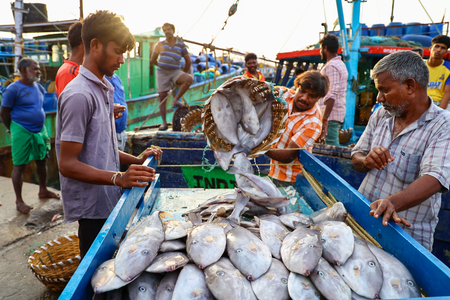
New Delhi- India’s seafood exports recorded a 13.93 per cent increase in value during April–October 2025, rising to USD 4,793.08 million from USD 4,207.08 million in the same period last year, the government announced on Friday. It also stated that both the volume and value of shrimp exports to the United States have remained strong over the past five years.
However, shipments of frozen shrimp to the US softened during the same period. Highlighting the government’s response, Minister of State for Commerce and Industry Jitin Prasada informed the Rajya Sabha that market diversification initiatives have been intensified, including multiple buyer–seller meets.
Provisional data shows frozen shrimp exports to the US declined to 55,282 tonnes valued at USD 512.81 million in August–October 2025, from 83,375 tonnes worth USD 673.98 million during the same period in 2024.
The minister added that the Marine Products Export Development Authority (MPEDA) has actively participated in major global seafood fairs across Asia and Europe. Reverse Buyer–Seller Meets held in Chennai and New Delhi in 2025 enabled more than 100 interactions between international buyers and Indian exporters.
MPEDA is also conducting sensitisation programmes on various free trade agreements (FTAs) to help exporters leverage new opportunities.
To address market access challenges, the Department of Commerce is accelerating FTA negotiations, including discussions with the European Union. Meanwhile, the Department of Fisheries is engaging with several APAC countries to strengthen quality assurance, biosecurity frameworks, cold-chain infrastructure, and R&D collaboration.
Support measures for shrimp farmers include capacity-building initiatives, awareness drives, farm monitoring, and aquaculture technician training.
MPEDA has also undertaken domestication of tiger shrimp in Visakhapatnam to produce SPF (Specific Pathogen Free) tiger shrimp broodstock from Indian strains.
Further, MPEDA has implemented the ‘SHAPHARI Certification’ for farms and hatcheries to assure buyers that products are antibiotic-free, disease-free, and produced using Best Management Practices.
To boost production, an Advanced Technological Transformation in Aquaculture scheme has been launched, promoting bio-secured circular tank systems and offering financial assistance covering 50 to 75 per cent of capital costs.
Additionally, GST rates on more than 20 fisheries and aquaculture-related items—such as farm equipment, feed ingredients, water conditioners, and fishing nets—have been reduced from 12–18 per cent to 5 per cent to lower costs and enhance industry competitiveness.
–With inputs from IANS