
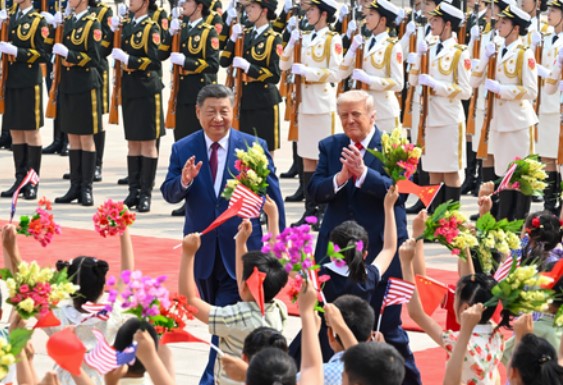
Sofia: India is increasingly pursuing a policy of “strategic neutrality” in its relations with both the United States and China, carefully balancing partnerships with the world’s two largest powers while safeguarding its own national interests, according to a report published by Bulgaria-based Modern Diplomacy.
The report argues that India’s approach reflects a broader trend among major Global South nations such as Indonesia, Brazil and Saudi Arabia, which are navigating the growing rivalry between Washington and Beijing through pragmatic, interest-driven diplomacy rather than aligning exclusively with either side.
According to the report, India’s participation in the Quadrilateral Security Dialogue (Quad) demonstrates its willingness to cooperate with like-minded countries on issues such as maritime security, technology, infrastructure, climate initiatives, and critical mineral supply chains. The Quad, comprising India, the United States, Japan and Australia, gained renewed momentum in 2017 amid concerns over China’s expanding influence in the Indo-Pacific region.
However, the report notes that India’s engagement with the Quad has not prevented it from maintaining robust economic ties with China. Instead, New Delhi has adopted a balancing strategy that seeks to benefit from relationships with both powers without becoming overly dependent on either.
The analysis describes India’s post-2014 foreign policy as one rooted in strategic autonomy, aimed at building beneficial international partnerships while avoiding rigid ideological or value-based alliances. This approach allows India to cooperate with different countries based on shared interests rather than bloc politics.
A major factor driving closer US-India cooperation is India’s strategic location in the Indo-Pacific, a region that has become central to global geopolitical competition. The report states that Washington views India as a key partner in maintaining regional stability and counterbalancing China’s influence.
Since the United States lacks a permanent geographical presence across much of the Indo-Pacific beyond its military installations, strengthening ties with India enables Washington to expand its strategic footprint through cooperation in infrastructure, technology and security initiatives.
At the same time, the report highlights that India has remained cautious in its dealings with the US, particularly during the early phase of President Donald Trump’s administration, when policy unpredictability prompted New Delhi to reassess aspects of the bilateral relationship. The report suggests that India seeks to preserve mutually beneficial cooperation while avoiding excessive dependence on any single partner.
On relations with China, the report notes that despite ongoing border disputes and strategic competition, economic ties between the two countries remain significant. India and China resumed trade relations through a trade agreement in 1984 following years of strained ties after the 1962 conflict, and economic interdependence has continued to grow over the decades.
The report concludes that India’s ability to engage simultaneously with both Washington and Beijing reflects an evolving foreign policy model in which countries seek flexibility and strategic space amid an increasingly bipolar global order, rather than choosing sides in great-power competition.
With inputs from IANS