
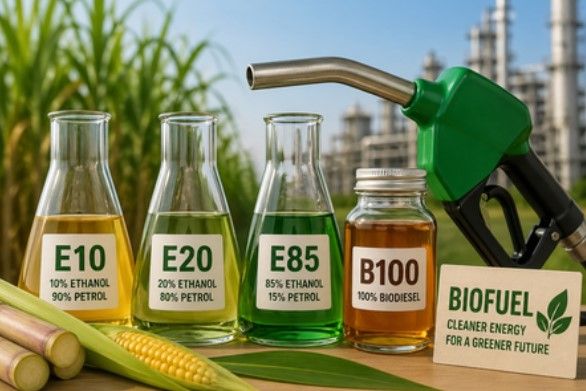
New Delhi: The Centre is considering a significant push towards cleaner transport by proposing wider use of alternative fuels, including higher blends of ethanol and biodiesel, under updated vehicle regulations.
According to a draft notification issued by the Ministry of Road Transport and Highways, the government plans to amend the Central Motor Vehicles Rules, 1989. The proposal allows vehicles to run on ethanol blends as high as 100 per cent (E100) and 85 per cent (E85), along with biodiesel blends up to 100 per cent (B100).
At present, most vehicles manufactured after April 2023 are compatible with E20 fuel—containing up to 20 per cent ethanol—while select models are already designed to handle higher blends.
The draft also includes technical updates, such as correcting the terminology for hydrogen-CNG fuel from “Hydrogen + CN” to “Hydrogen + CNG,” along with revisions in emission-related tables.
In a parallel move, the government has proposed increasing the permissible gross vehicle weight for certain categories from 3,000 kg to 3,500 kg, potentially allowing greater load capacity.
The notification has been opened for public consultation, with stakeholders invited to submit feedback within 30 days before finalisation.
Officials say the changes are aimed at aligning regulations with evolving fuel technologies while reducing India’s dependence on fossil fuel imports. Union Minister Nitin Gadkari has repeatedly emphasised scaling up ethanol usage, even suggesting that India should work towards achieving 100 per cent ethanol blending in the long run to strengthen energy security.
Globally, countries like Brazil have already adopted higher ethanol blending levels, offering a potential roadmap for India’s transition.
Separately, the government is also pushing biofuel adoption in aviation. The Ministry of Petroleum and Natural Gas has amended norms to permit ethanol blending in aviation turbine fuel (ATF), aiming to cut crude imports and lower emissions.
India has also set indicative targets for sustainable aviation fuel (SAF) blending—1 per cent by 2027, 2 per cent by 2028, and 5 per cent by 2030—aligning with global sustainability goals in the aviation sector.
WIth inputs from IANS