
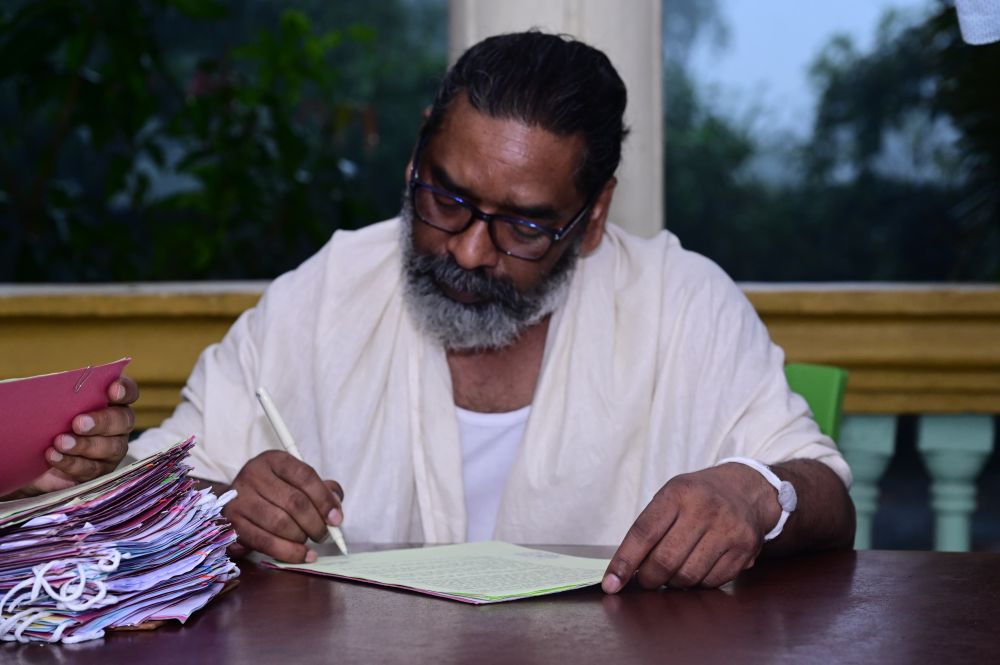
Ranchi: In April, during the Jharkhand Mukti Morcha convention, Hemant Soren was entrusted with greater responsibility by his father and party patriarch Shibu Soren. Few could have imagined that within just four months, Hemant would have to bid farewell to his father, popularly known as Dishom Guru. Despite the blow, destiny’s will remains unquestionable. After days of treatment at Delhi’s Sir Ganga Ram Hospital, Shibu Soren passed away on August 4. Chief Minister Hemant Soren shared the heartbreaking news with the public through an emotional tweet.
In a time marked by professional compulsions, many children today struggle to even attend their parents’ last rites. The COVID-19 pandemic reminded us of such painful realities, when many sons couldn’t perform their mother’s final rituals. According to Indian tradition, the elder son performs the father’s cremation while the younger does the mother’s. But during the pandemic, these customs were often left unfulfilled. In contrast, Hemant not only performed his father’s last rites in their native village but chose to stay back and observe all associated traditions with sincerity.
Throughout this period, Hemant remained engaged in governance, overseeing administrative affairs remotely, ensuring that the functioning of the state remained unaffected. Despite a steady stream of political and public visitors at his village residence, he has managed to strike a balance between personal mourning and public duty—an example rarely seen in today’s political landscape.
Hemant Soren’s political journey has been a tale of resilience. Once seen as reluctant in politics, his rise has been marked by strong comebacks and increasing public acceptance. Despite losing power in 2014, he strengthened his position in subsequent elections. In 2009, JMM won 18 seats and joined hands with BJP to form the government, a move shaped largely by Hemant’s political calculation. In 2014, the party won 19 seats. In 2019, JMM became the single largest party with 30 seats, reducing BJP to 25. Even Chief Minister Raghubar Das lost his seat.
In 2024, Hemant scripted history again, with JMM securing 34 seats while BJP fell to 21. Santhal Pargana emerged firmly as JMM’s stronghold. Former BJP leader Louis Marandi, denied a ticket by her party, won on a JMM ticket. Sita Soren lost. The exit of senior leader Champai Soren raised concerns, but it caused no dent to the party’s fortunes. The public narrative shifted—if Hemant is there, courage follows.
Hemant’s wife, Kalpana Soren, has also emerged as a key political figure. As a star campaigner, she not only complemented Hemant’s presence but also proved to be a challenge the opposition could not counter. Her growing influence has signaled a new direction in JMM’s leadership dynamics, with even Hemant’s younger brother Basant reportedly sensing the difference in public appeal between them.
Hemant’s brief stint in jail during an Enforcement Directorate probe, followed by a landslide electoral victory, further solidified his image as a people’s leader. His appearance during that time—with a distinct hairstyle—reminded many of Shibu Soren himself, evoking a visual continuity of legacy.
Thousands have been reaching Nemra to pay their last respects to Dishom Guru. But the manner in which Hemant has held together both his family and party during this emotionally charged period speaks volumes of his leadership. He may not fill the void left by his father, but he has certainly proven capable of carrying forward his legacy with strength, patience, and political maturity.
Story by Manish Raj