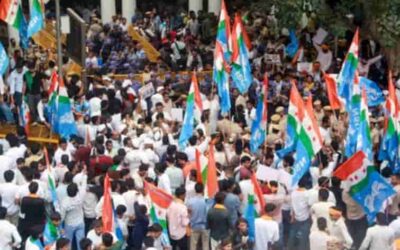
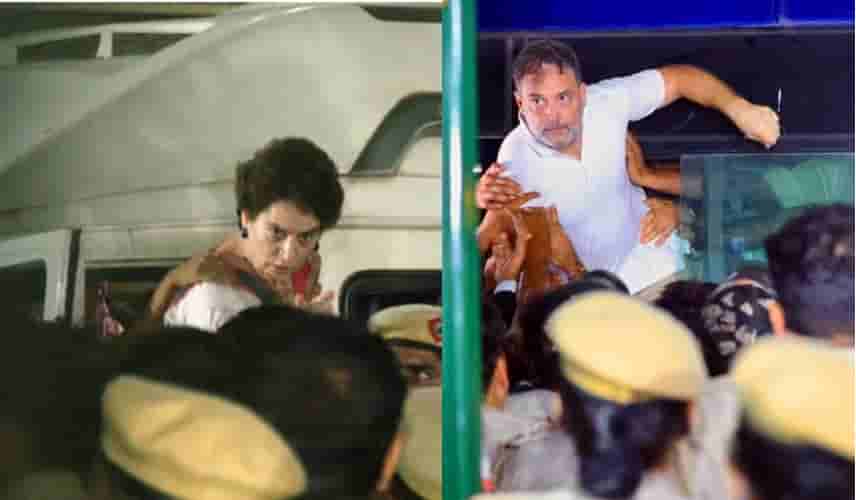
New Delhi- The recent political conduct of Congress leaders Rahul Gandhi and Priyanka Gandhi Vadra has been striking. From pushing and jostling with police personnel to hanging from a bus, the Gandhi siblings appear to have embraced a more confrontational style of street politics.
Rahul Gandhi and the Congress have long been vocal critics of Prime Minister Narendra Modi, often using sharp language to target him and the BJP. Now, the confrontation is increasingly playing out on the streets, with protests involving clashes with police, attempts to enter government offices, sit-ins on roads and heated exchanges with security personnel.
The style of these demonstrations resembles the protests led by the CJP in July, following which Union Education Minister Dharmendra Pradhan resigned.
However, the Congress’s street-level aggression may be about more than confronting the BJP. It could also reflect the party’s efforts to establish its position within the Opposition, where several leaders have independent political bases and ambitions. With the BJP firmly established as the dominant force in national politics, the contest for the second position in the Opposition camp is becoming increasingly significant.
Rahul Gandhi is the Leader of the Opposition in the Lok Sabha, but that position does not automatically make the Congress the undisputed leader of all Opposition parties. Several regional leaders have built strong political bases and may be reluctant to accept the Gandhis’ leadership without question.
Aam Aadmi Party chief Arvind Kejriwal is one example. He has cultivated his own political identity and repeatedly positioned himself as a challenger to the BJP. During the CJP-led protest at Jantar Mantar in July, Kejriwal and other AAP leaders supported the agitation, while the Congress organised a separate protest over the NEET issue.
The differences became apparent again during the recent protest against the Election Commission. The AAP did not participate in the Congress-led Opposition meeting and march to President Droupadi Murmu. Its absence assumes significance as the Congress seeks to establish itself as the principal voice of the Opposition.
While Rahul and Priyanka Gandhi are trying to keep the Congress at the centre of the political debate, Kejriwal has his own political calculations and an independent identity to protect. The two parties may oppose the BJP on several issues, but that does not guarantee their participation in every joint political programme.
Samajwadi Party chief Akhilesh Yadav also has his own priorities. With the 2027 Uttar Pradesh Assembly elections approaching, his immediate focus is on protecting and expanding his party’s strong organisational base in the state. Although he joined Rahul Gandhi and other INDIA bloc leaders in the recent march towards the Election Commission, his principal political battle remains in Uttar Pradesh.
The Congress may want to project itself as the national face of the Opposition, but Akhilesh cannot afford to overlook his state-level ambitions.
This is where the competition becomes particularly interesting. Rahul Gandhi wants to lead the national Opposition campaign, Kejriwal seeks to preserve his independent political standing, and Akhilesh Yadav is focused on strengthening the Samajwadi Party’s position in Uttar Pradesh. Other regional leaders have their own ambitions and constituencies to protect.
These parties may unite to protest against the government, but questions of leadership, seat-sharing and electoral strategy can expose their competing interests.
The Gandhi siblings, therefore, have strong political reasons to remain in the spotlight. Street protests offer them an opportunity to project themselves as leaders willing to confront the government directly and keep the Congress central to the political conversation. Cameras capture every confrontation, while social media ensures that dramatic moments reach audiences far beyond the protest site.
There is, of course, nothing inherently wrong with political leaders taking to the streets. Protests are an essential part of democracy, and Opposition parties have every right to question the government, challenge its decisions and demand accountability.
However, a protest does not necessarily become more effective simply because it is louder, more confrontational or produces compelling television footage. The real question is what these demonstrations achieve for the Congress and the wider Opposition.
Recent bypoll results underline the challenges facing the Congress. The party lost the Nagaon Lok Sabha seat in Assam, which it had previously won, while the BJP recorded significant victories in Assam and West Bengal. These results do not settle allegations of vote theft, but they highlight the electoral difficulties confronting the Congress.
Keeping an issue alive through protests is not enough. The party must also persuade voters, strengthen its organisational machinery and translate political messaging into electoral support.
Indian politics has never been short of dramatic protests. Leaders have courted arrest, staged sit-ins, marched towards government offices and confronted police personnel for decades. What has changed is the speed with which every incident becomes social media content.
A political argument that takes several minutes to explain can be reduced to a few seconds of pushing, jostling or hanging from a vehicle. The more dramatic the footage, the greater its potential to go viral.
The Gandhi siblings appear to be navigating this environment, where political protest can also become a form of public spectacle. But there is a fundamental difference between being seen fighting for a cause and making tangible progress on it. A viral moment can generate instant attention, while political credibility takes sustained effort to build.
With seven states scheduled to hold Assembly elections in 2027, competition within the Opposition is likely to intensify. Uttar Pradesh will be particularly important, given the Samajwadi Party’s position and the Congress’s efforts to expand its political footprint. Punjab and Goa will test the AAP, while other parties will face their own electoral challenges.
Each party will seek to demonstrate its relevance, claim a greater role in the Opposition and prevent itself from being pushed to the margins.
Street protests and political confrontations are therefore unlikely to disappear soon. The larger question is whether these activities will help the Opposition build a credible, common political alternative or deepen divisions and rivalries among its leaders.
As the contest for the second position in national politics grows sharper, Rahul and Priyanka Gandhi may have more street-level confrontations ahead. Kejriwal, Akhilesh Yadav and other Opposition leaders will also seek to protect their political space.
Ultimately, however, political strength is determined by public support. Liking, disliking or sharing a social media reel is one thing; casting a vote at the ballot box is quite another. When elections arrive, it is the voters, not the cameras or social media, who have the final say.
–IANS