
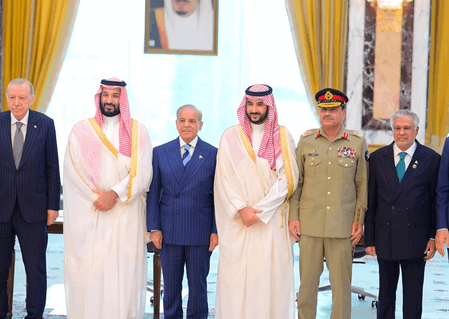
Ottawa — The recently signed Mecca Joint Defence Agreement between Saudi Arabia, Pakistan and Turkey could face serious challenges because of differences in the three countries’ political outlooks, strategic priorities and perceptions of regional threats, a report has said.
The trilateral pact, which is being presented as a NATO-like security arrangement, comes at a time of major geopolitical shifts in the Middle East. The agreement includes a provision similar to NATO’s Article 5, under which an armed attack on one member is treated as an attack on all three.
A report published by Canada-based Geopolitical Monitor said the changing security environment in the Middle East, particularly amid the Iran conflict and repeated attacks on US bases in the Gulf, has encouraged regional countries to reconsider their dependence on Washington for defence and security.
The report noted that the Mecca Agreement represents one of the clearest signs of this shift, with Saudi Arabia, Turkey and Pakistan seeking closer defence cooperation. However, it questioned whether the three countries have enough common strategic interests to sustain such an alliance over the long term.
One of the major concerns is that the countries do not necessarily share the same view of potential adversaries. The report pointed to Saudi Arabia’s growing relationship with India and raised the question of how Riyadh would respond if Pakistan were involved in a future conflict with New Delhi.
The issue is not entirely theoretical. In the past, Saudi Arabia sought military support from Pakistan for its intervention in Yemen, but Pakistan’s Parliament decided against joining the conflict. The episode demonstrated that Islamabad’s military decisions are ultimately shaped by its own national interests.
The report therefore questioned whether the three signatories would automatically come to each other’s aid in a crisis, despite the pact’s collective-defence provision. Even if they did decide to provide assistance, the scale and nature of that support could vary considerably depending on the circumstances.
The comparison with NATO also highlights another major difference. NATO developed around a relatively strong combination of shared security interests, political values and institutional commitments. The Mecca Agreement does not have a similarly strong ideological or political foundation, according to the report.
The three countries also follow markedly different political models. Saudi Arabia is an Islamic monarchy pursuing economic and social reforms while maintaining the country’s position as a leading Islamic power. Pakistan is formally a democracy but has historically experienced strong military influence in politics and has frequently used religion as an element of state policy.
Turkey, meanwhile, is a formally democratic republic whose political system has increasingly been influenced by political Islam under President Recep Tayyip Erdogan’s leadership.
At the same time, Saudi Arabia has traditionally viewed political Islam movements, particularly the Muslim Brotherhood, as a threat to the stability of its ruling system. This creates another potential source of friction with Turkey, which has maintained closer ties with some political-Islamist movements.
These differences raise questions about whether the Mecca Agreement is primarily a long-term military alliance or a strategic response to the rapidly changing security environment in the Middle East.
For now, the pact provides its three members with a framework for closer defence cooperation. But its real strength is likely to be tested only if one of the signatories faces a serious military crisis and the others are forced to decide how far they are prepared to go in its support.
With inputs from IANS