

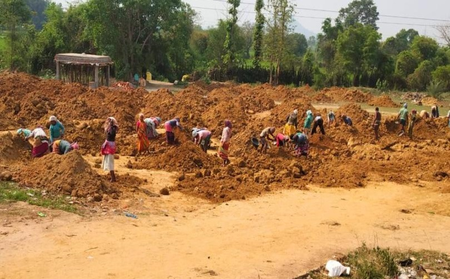
New Delhi- A proposed Bill seeking to repeal the 20-year-old Mahatma Gandhi National Rural Employment Guarantee Act (MGNREGA) aims to address the realities of a transformed rural India, including a guaranteed increase in employment days from 100 to 125 per rural household, a senior official said on Monday.
The proposed Viksit Bharat Guarantee for Rozgar and Ajeevika Mission (Gramin) (VB–G RAM G) Bill, 2025, which is slated to be introduced in the Lok Sabha, incorporates AI-based fraud detection mechanisms and mandates stronger social audits—twice a year for every Gram Panchayat—to significantly enhance transparency and accountability.
According to an official from the Ministry of Rural Development, the new legislation is designed not only to generate rural employment but also to directly benefit farmers by improving labour availability and strengthening agricultural and rural infrastructure.
The Bill, listed in the supplementary list of business issued on Monday, seeks to address structural weaknesses in the existing scheme, expand employment opportunities, and ensure better coordination in asset creation aligned with national development priorities.
Describing the Bill as a major upgrade over MGNREGA, the official said it establishes a modern statutory framework aligned with the vision of Viksit Bharat 2047. It guarantees 125 days of wage employment per rural household whose adult members volunteer to undertake unskilled manual work.
The proposed legislation focuses on creating both employment and durable rural assets through four priority verticals: water security through water-related works; core rural infrastructure; livelihood-related infrastructure; and special works aimed at mitigating the impact of extreme weather events.
While the number of Aadhaar-seeded active workers under MGNREGA has risen sharply—from 76 lakh in FY 2013–14 to 12.11 crore in FY 2025–26—the existing scheme continues to suffer from structural challenges. These include persistent misappropriation of funds, bypassing of digital attendance systems, and a mismatch between expenditure and asset creation, the official noted.
“The scale and persistence of these issues clearly showed that MGNREGA’s architecture had reached its limits, making a new and modernised VB–G RAM G framework essential,” the official said.
Systemic failures and corruption, particularly in states such as West Bengal, further underscored the need for reform. Investigations across 19 districts in the state revealed non-existent works, rule violations, and misuse of funds, leading to the freezing of allocations.
Monitoring across 23 states in FY 2025–26 found instances where works were either not found on the ground or were disproportionate to reported expenditure. Other issues included the use of machines where manual labour was mandated and widespread bypassing of the MGNREGA Mobile Monitoring System for attendance tracking.
In FY 2024–25 alone, misappropriation across states amounted to Rs 193.67 crore, while only 7.61 per cent of households completed the full 100 days of employment in the post-pandemic period.
Officials said these deep-rooted problems—ranging from fund leakages and weak verification to poor compliance—necessitated a comprehensive overhaul rather than incremental reforms.
They also pointed out that MGNREGA was enacted in 2005, while rural India has undergone significant transformation over the past two decades. Poverty levels have declined sharply, from 25.7 per cent in 2011–12 to 4.86 per cent in 2023–24, supported by rising consumption, higher incomes, and expanded financial inclusion, as reflected in MPCE and NABARD RECSS surveys.
“With stronger social protection systems, improved connectivity, deeper digital penetration, and more diversified rural livelihoods, the existing framework no longer aligns with the present-day rural economy,” the official said.
With inputs from IANS