
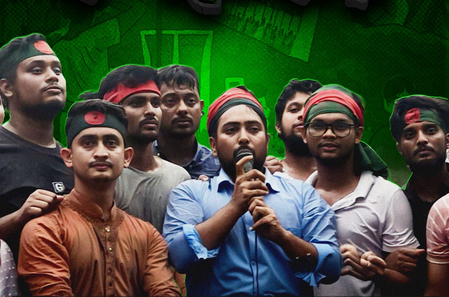
Washington — A recent report has suggested that while Gen-Z-led protests have gained momentum globally, they have largely failed to translate public demonstrations into electoral victories or lasting policy influence, citing the latest election results in Bangladesh as a key example.
Writing for the Council on Foreign Relations, Senior Fellow Joshua Kurlantzick noted that the protests which led to the ousting of former Prime Minister Sheikh Hasina in August 2024 marked one of the first major Gen-Z protest successes in Asia. The movement also inspired similar demonstrations in Nepal, where protests brought down a Prime Minister, and Indonesia, where demonstrations temporarily stalled political developments. The influence of these movements reportedly extended to Madagascar and other regions.
However, Kurlantzick argued that despite their widespread mobilisation, Gen-Z protests have largely failed to achieve meaningful electoral or policymaking success. He pointed out that in Thailand, the youth-supported People’s Party suffered a major defeat in national elections. Similarly, in Japan, the long-dominant Liberal Democratic Party successfully fended off challenges from several Gen-Z-oriented parties to secure a decisive electoral victory.
In Bangladesh, although Sheikh Hasina’s exit marked a significant political shift, the elections were overwhelmingly won by the Bangladesh Nationalist Party (BNP), which has historically shared political dominance with rival parties. The BNP secured a landslide victory but continues to face public scepticism despite promising reforms.
Meanwhile, the National Citizen Party (NCP), formed by student leaders from the 2024 protests, managed to win only six out of the 30 parliamentary seats it contested, which Kurlantzick described as a weak performance.
The report highlighted that voters supported the BNP largely due to expectations of constitutional reforms aimed at strengthening democracy, expanding economic and political opportunities, and tackling corruption. However, the party’s ability to implement these reforms remains uncertain and will determine whether Bangladesh’s political system can overcome longstanding challenges.
Kurlantzick also noted that the Jamaat-e-Islami emerged as the second-largest political force in the election. Although the party attempted to rebrand its image during the campaign, it has previously faced allegations of involvement in political violence and has been criticised for its conservative and misogynistic positions.
While the election process itself was largely considered free and fair on polling day, the report mentioned that incidents of political violence and killings occurred in the lead-up to voting, reflecting persistent instability in Bangladesh’s political landscape.
With inputs from IANS