
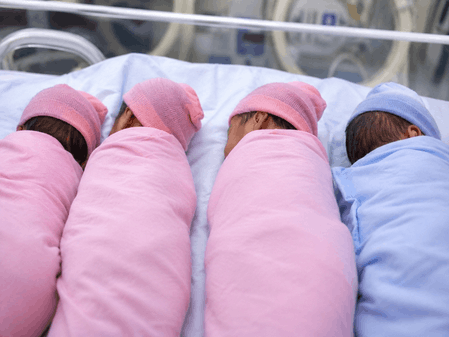
Jaipur- In a rare medical occurrence, a woman from Rajasthan’s Jhalawar district has given birth to quadruplets—three girls and a boy—at Hira Kunwar Ba Women’s Hospital. The babies were delivered through a Caesarean section and are currently receiving specialised treatment in the Neonatal Intensive Care Unit (NICU) after being born prematurely.
Jyoti Kashyap, wife of Arun Kashyap and a resident of Bhoi Mohalla in Jhalawar city, delivered the four babies at around 11:50 a.m. on Wednesday. Doctors at the hospital described the case as highly unusual, noting that quadruplet pregnancies are extremely rare.
According to hospital officials, all four babies were born at approximately 29 weeks of gestation. Owing to their premature birth and low birth weight, they have been admitted to the NICU for continuous monitoring and advanced medical care.
Paediatrician Dr. Naresh Meena said the newborns have underdeveloped lungs and require respiratory support along with specialised neonatal treatment.
Three of the babies weigh around 1.1 kg each, while the fourth baby girl weighs approximately 1.2 kg. Doctors pointed out that a healthy full-term newborn typically weighs at least 2.5 kg, making intensive monitoring crucial in this case.
The infants are being cared for by a dedicated team of specialists, including resident doctors Dr. Vishal Nagar and Dr. Vijay Bakoliya.
Calling it a once-in-a-career experience, Dr. Vishal Nagar said quadruplet pregnancies are exceptionally uncommon and that this was the first time he had witnessed the birth of four babies in a single delivery.
This is Jyoti Kashyap’s second pregnancy. The couple already has a four-year-old daughter.
Hospital authorities said the mother is in stable condition and has been shifted to the gynaecology ward, while the four newborns continue to receive intensive medical attention. Doctors remain optimistic but said the coming days will be critical as the babies require close observation due to their premature birth and low birth weight.
With inputs from IANS