
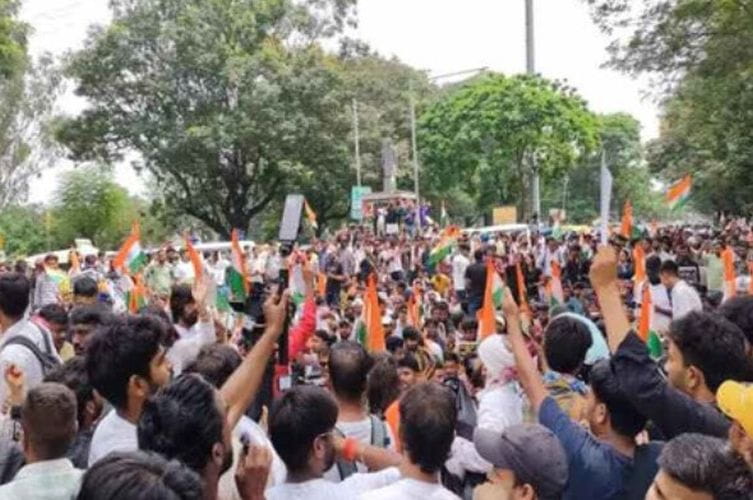
Ranchi: The student agitation in Ranchi over alleged irregularities in government recruitment examinations entered its 20th consecutive day on Wednesday, with the standoff between the protesters and the state government showing no signs of easing.
The agitation has continued despite an Assembly gherao, police action and several rounds of talks between student representatives and the government. At the centre of the deadlock are two major demands raised by the protesters, neither of which has so far found acceptance from the state government.
The first demand is the cancellation of the 2024 JSSC-CGL examination. More than 2,000 candidates have already been appointed through the examination and are currently working in different government departments.
The government has maintained that cancelling the examination at this stage would be difficult. Officials point out that allegations of irregularities have previously been examined and that the matter has also reached both the Jharkhand High Court and the Supreme Court.
According to the state government, the recruitment process moved ahead only after court proceedings cleared the way for the appointments. The government has also pointed to the ongoing CID investigation into complaints related to the examination as an important part of the process to establish whether any wrongdoing took place.
Students, however, remain unconvinced by the state government’s position. Protest leaders have questioned the effectiveness and independence of the CID investigation and alleged that the agency failed to place adequate evidence concerning the alleged irregularities before the courts.
The arrest of Abhay Tiwari, who has been linked to the examination outsourcing agency TDAPL, has further intensified the students’ concerns. According to student groups, Tiwari worked as a marketing manager with the agency and was subsequently selected for the post of Block Supply Officer through the same examination.
The protesters argue that his alleged connection with the agency and subsequent selection raise questions about the integrity of the recruitment process and warrant a fresh examination of the entire recruitment.
However, legal experts caution that an arrest alone cannot be treated as judicial proof of large-scale examination manipulation. Whether the allegations are established will ultimately depend on the evidence collected during the investigation and the findings of the courts.
The students’ second major demand is a CBI investigation into alleged irregularities in all disputed examinations conducted by the Jharkhand Public Service Commission (JPSC) and Jharkhand Staff Selection Commission (JSSC).
The state government has not accepted the demand for a CBI probe. Instead, it has proposed setting up a high-level committee headed by a retired judge to examine the allegations and related concerns.
Student leaders have rejected the proposal, arguing that they have lost confidence in inquiries conducted by state agencies. They want the investigation to be handed over to an independent central agency, which they believe would be better placed to examine allegations involving government recruitment bodies.
Beyond the two specific demands, the prolonged agitation has also highlighted a larger issue — the growing trust deficit between job aspirants and the recruitment system. For thousands of students preparing for government examinations, allegations of paper leaks, manipulation or procedural irregularities can have consequences extending far beyond a single examination.
The government, meanwhile, faces the challenge of addressing these concerns without disrupting appointments that have already been made or undermining the legal process. A credible and transparent investigation could therefore be crucial in resolving the current impasse.
With the protest entering its third week, a breakthrough will likely depend on whether the government and student representatives can find common ground on an investigation mechanism that addresses the protesters’ demand for accountability while also taking into account the legal status of the recruitment process.
For now, however, the deadlock continues, with students refusing to withdraw their agitation and the government maintaining its position on both demands.
With inputs from IANS