
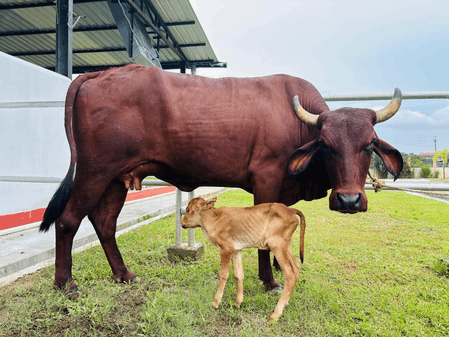
Guwahati: Assam has achieved a significant breakthrough in livestock biotechnology with the birth of what Chief Minister Himanta Biswa Sarma described as the world’s first IVF-born female calf of the indigenous Lakhimi cattle breed.
Sarma announced the development on Saturday, calling it a historic achievement that brings together Assam’s traditional livestock heritage and advances in reproductive technology.
“The world’s first IVF female calf of the Lakhimi breed — native to Assam — has been born at the Assam Veterinary and Fishery University,” the Chief Minister said in a post on X.
The calf was born through in-vitro fertilisation technology at the IVF Laboratory of the College of Veterinary Science under Assam Veterinary and Fishery University at Khanapara in Guwahati. The laboratory was established with support from the Rashtriya Gokul Mission, a central initiative focused on the development and conservation of indigenous cattle breeds.
The achievement is particularly important for the Lakhimi breed, which is native to Assam. Scientists can use assisted reproductive technologies such as IVF and embryo transfer to multiply animals with desirable genetic traits more quickly than through conventional breeding alone. This could help preserve the breed while gradually improving productivity.
The technology also has wider potential for Assam’s dairy sector. According to the Chief Minister, scientific breeding interventions could support indigenous breed conservation, better disease management and increased milk production. Over time, improved livestock productivity could translate into stronger dairy incomes for farmers.
Sarma congratulated the veterinary scientists and professionals involved in the project, saying their work could open a new chapter for Assam’s dairy and livestock economy.
The development also builds on the state’s recent progress in assisted reproduction technology. Earlier this year, scientists at the veterinary college produced Assam’s first IVF-born calf, a female Gir calf born in Sonapur. That achievement demonstrated the potential of embryo-transfer technology under local conditions and provided a foundation for further work involving indigenous breeds.
For farmers, the significance of such technology lies in its potential to shorten the time required to multiply genetically superior cattle. If successfully adopted on a larger scale, it could help improve the quality of livestock available to dairy farmers while reducing the risk of losing valuable indigenous genetic traits.
The birth of the Lakhimi calf therefore represents more than a one-off scientific achievement. It highlights how modern biotechnology can be used alongside breed conservation efforts, potentially giving Assam a new tool to protect its indigenous cattle while strengthening milk production and the rural economy.
Sarma described the newborn calf as small in size but large in scientific significance and concluded his message by invoking “Gau Mata”, underscoring the cultural as well as economic importance attached to cattle in the state.
With inputs from IANS