
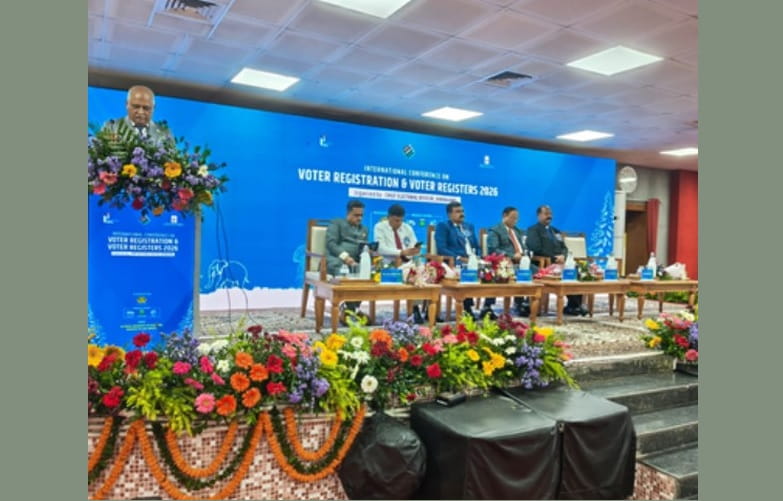
Ranchi- Election administrators, researchers and academics from India and abroad gathered in Ranchi on Wednesday for a two-day international conference focused on improving voter registration systems and making electoral rolls more accurate, inclusive and resilient.
The conference, titled “Voter Registration and Voter Register-2026”, is examining how election authorities can use advanced technology to identify fake and duplicate entries while ensuring that decisions are backed by effective field-level verification.
The discussions assume added significance as increasing migration, rapid urbanisation and changing population patterns make it more difficult for election authorities to keep voter databases updated.
The event is being jointly organised by the Office of the Chief Electoral Officer, Jharkhand, and the Central University of Jharkhand at the National University of Study and Research in Law (NUSRL) in Ranchi.
Election Commission Principal Secretary Arvind Anand attended the inaugural session as the chief guest.
Jharkhand Chief Electoral Officer K. Ravi Kumar said the conference is intended to provide a platform for wider discussions on voter registration and electoral roll management and is not limited to the ongoing Special Intensive Revision (SIR) exercise in the state.
“Bringing together the practical experiences of election administrators and academic research can help make electoral rolls more reliable and inclusive,” he said.
The scale of academic participation reflects the growing interest in electoral-roll management as a subject of research. Ravi Kumar said more than 800 universities and institutions were approached for participation, resulting in 230 abstracts. Of these, 80 were shortlisted and 58 research papers were selected for discussion and publication.
Six technical sessions were held on the opening day, covering international experiences from countries including Estonia, Brazil, Australia, Canada, Denmark, Ghana and South Africa.
The sessions examined a wide range of issues, including online voter registration, voter databases, emerging technologies and strategies to improve voter awareness.
A major area of concern was the registration of migrant voters. Experts discussed the difficulties faced by workers and other mobile populations who frequently move between states or regions for employment, often making it difficult for them to update their electoral records promptly and maintain continuity in registration.
The conference also looked at ways of improving participation among groups that can face greater barriers to accessing electoral services, including rural and marginalised communities, tribal populations, people living in border areas, women and migrant workers.
Participants discussed the role of social media and multilingual awareness campaigns in reaching communities more effectively and encouraging eligible citizens to register and keep their details updated.
Artificial intelligence and digital systems were among the most closely discussed emerging areas. While technology can make voter registration and electoral-roll management faster and more efficient, experts stressed that automated systems should not replace human scrutiny.
The emphasis on human oversight is particularly important when technology is used to identify potentially duplicate, incorrect or ineligible records. Participants stressed that final decisions should be supported by appropriate verification mechanisms to reduce the risk of genuine voters being wrongly excluded.
NUSRL Vice-Chancellor Prof (Dr) Ashok R. Patil described electoral rolls as the foundation of democratic participation. He stressed the need to ensure that every eligible citizen is included while preventing fake, duplicate and ineligible names from entering the rolls.
Central University of Jharkhand Vice-Chancellor Prof Sarang Medhekar called for sustained cooperation between electoral institutions and academic organisations. He acknowledged the potential of AI and other emerging technologies to transform election management but stressed that data security and associated risks must be addressed alongside technological innovation.
Dr Father Robert Pradeep Kujur, Principal of St Xavier’s College, Ranchi, emphasised the role of educational institutions in bringing young voters, migrants and disadvantaged sections closer to the electoral process. He said colleges and universities could become important partners in voter-awareness and registration campaigns.
The conference comes at a time when election authorities are increasingly looking at digital tools to manage massive voter databases. However, discussions in Ranchi highlighted that technology alone cannot guarantee accurate electoral rolls. A combination of reliable databases, secure digital systems, field verification, public awareness and human oversight will remain essential to balancing electoral integrity with the right of every eligible citizen to participate.
The findings and recommendations emerging from the two-day conference will be published in both print and digital formats and are expected to provide material for future research as well as possible improvements in electoral-roll management.
With inputs from IANS