
Bratislava/New Delhi — Prime Minister Narendra Modi presented a carefully curated collection of traditional Indian handicrafts, ancient Ayurvedic texts, and regional delicacies to Slovakia’s top leaders during his landmark visit to the country, highlighting India’s rich cultural heritage and centuries-old traditions.
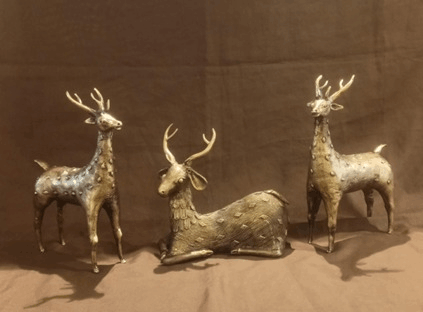
For Slovak President Peter Pellegrini, PM Modi selected a set of handcrafted Thewa motif cufflinks, a Himroo silk tie and pocket square set, and a brass Dokra antelope sculpture ensemble.
The Thewa cufflinks represent the famed jewellery craft of Rajasthan’s Pratapgarh district. Created using the rare Thewa technique, artisans fuse intricately engraved gold sheets onto coloured glass to produce elegant designs inspired by nature and traditional symbolism. The craft, which has received Geographical Indication (GI) status, remains one of Rajasthan’s most distinctive artistic traditions.
The Himroo silk tie and pocket square reflect the renowned weaving heritage of Aurangabad (Chhatrapati Sambhajinagar) in Maharashtra. Crafted from a silk-cotton blend, Himroo textiles are known for their soft texture, subtle sheen, reversible weave, and intricate floral and paisley motifs, making them a symbol of refined craftsmanship.
The brass Dokra antelope set showcases one of India’s oldest metal-casting traditions, practised by tribal artisans across Chhattisgarh, Odisha, Jharkhand, and West Bengal. Made using the traditional lost-wax casting technique, each piece is unique. The antelope figures symbolise grace, resilience, and harmony with nature, drawing a cultural parallel with Slovakia’s native Tatra chamois.
Prime Minister Modi also gifted a hand-knotted Kashmiri silk carpet to Slovak Prime Minister Robert Fico. Produced by skilled artisans in the Kashmir Valley, particularly around Srinagar, these carpets are celebrated worldwide for their intricate floral and paisley patterns, exceptional craftsmanship, and luxurious finish. Depending on the complexity of the design, a single carpet can take months or even years to complete.
To Richard Rasi, Speaker of Slovakia’s National Council, the Prime Minister presented traditional Thekua along with two of India’s most revered Ayurvedic texts — the Sushruta Samhita and the Charaka Samhita.
Thekua, a beloved sweet snack from Bihar and Jharkhand, is made from wheat flour, jaggery or sugar, fennel seeds, and ghee. Closely associated with the Chhath festival, it is valued for its simple ingredients, homemade flavour, and deep cultural significance.
The Sushruta Samhita, attributed to the ancient physician Sushruta, is regarded as one of the world’s earliest and most influential works on surgery. It details advanced surgical procedures, medical instruments, anatomy, and treatments, reflecting India’s pioneering contributions to medical science.
The Charaka Samhita, attributed to Acharya Charaka, is a foundational text of Ayurveda that offers a systematic understanding of health, disease, human physiology, and well-being. More than two millennia old, it remains a testament to India’s scientific and intellectual legacy and continues to attract global scholarly interest.
Through these thoughtfully chosen gifts, PM Modi not only showcased India’s diverse cultural and intellectual traditions but also strengthened the cultural bonds between India and Slovakia.
With inputs from IANS