
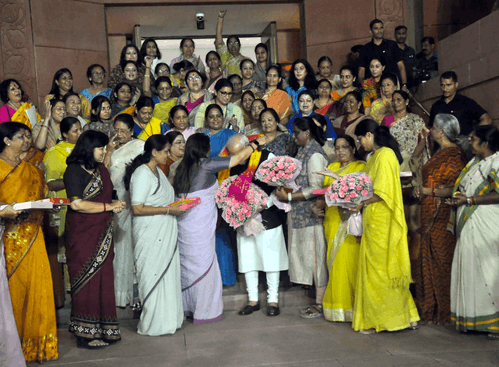
New Delhi — The Centre has moved to fast-track women’s political representation by introducing three key Bills in the Lok Sabha on April 16. The objective is to ensure that 33% reservation for women can be implemented sooner—potentially by the 2029 general elections.
Here’s a clear, simplified breakdown of the developments and what they mean:
What are the three new Bills?
The government introduced:
- The Constitution (One Hundred and Thirty-First Amendment) Bill, 2026
- The Delimitation Bill, 2026
- The Union Territories Laws (Amendment) Bill, 2026
These are aimed at accelerating the rollout of the Nari Shakti Vandan Adhiniyam, which provides 33% reservation for women in Parliament and state Assemblies.
Why were these Bills needed?
Under the existing framework, women’s reservation was tied to:
- The next Census
- A delimitation exercise (redrawing constituencies)
Both processes take time, meaning the benefits could have been delayed beyond 2029. The new Bills attempt to delink reservation from these delays, enabling earlier implementation.
What is delimitation and why is it important?
Delimitation is the process of redrawing constituency boundaries based on population changes. It ensures fair representation.
The current Lok Sabha seat cap (550) was set in 1976 when India’s population was about 54 crore. With the population now around 140 crore, the government argues that more seats are needed for fair representation.
Proposed increase in Lok Sabha seats
- Current elected seats: 543
- Proposed expansion: Up to 850 seats
The idea is a uniform 50% increase across states, ensuring no region loses its proportional share.
Will any state lose representation?
No. The proposal maintains proportional balance:
- Southern and smaller states will not lose influence
- Their share in Parliament remains nearly unchanged
- Every state simply gets more seats, not less share
Impact on SC/ST reservation
Delimitation would also proportionally increase reserved seats for Scheduled Castes and Scheduled Tribes, strengthening their representation in Parliament.
Why wasn’t it implemented in 2024?
Because delimitation is a complex process that typically takes around two years. The 2023 law created the legal framework, but implementation required further legislative steps—hence these new Bills.
What about religion-based reservation?
The Constitution does not allow reservation based on religion. Hence, there is no separate quota for Muslim women; reservations are based on social and economic backwardness.
Will current elections be affected?
No. Elections up to 2029 will continue under the existing system. Any changes will apply only after the new framework is fully implemented and approved.
Why a separate law for Union Territories?
Union Territories like Delhi, Jammu & Kashmir, and Puducherry have distinct legal frameworks. A separate amendment ensures women’s reservation is applied uniformly in these regions as well.
Bottom line
These Bills are an attempt to speed up women’s political representation by removing procedural bottlenecks. While the broader goal remains unchanged—33% reservation—the timeline could now shift forward, making implementation by 2029 more realistic.
If executed as planned, this would mark a significant structural change in India’s electoral system, expanding representation while maintaining federal balance.
With inputs from IANS