
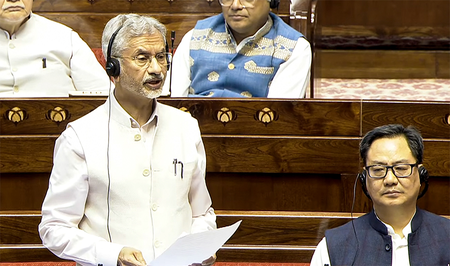
New Delhi: Opposition leaders on Monday criticised the Union government’s response to the escalating crisis in West Asia after External Affairs Minister S. Jaishankar made a statement in the Rajya Sabha on the ongoing conflict in the region.
Congress MP J.B. Mather said the global situation, particularly in the Middle East, was extremely tense and warranted a serious discussion in Parliament.
“The world is witnessing a very tense situation, especially in the Middle East. The oil crisis and the energy sector are being severely affected, and its impact is visible in India as well. The Sensex and Nifty are falling, affecting the stock market. These issues should be seriously discussed and deliberated during the Parliament session. It is not enough for a minister to simply make statements on such important matters,” Mather told IANS.
Echoing similar concerns, CPI(M) MP John Brittas strongly criticised the government’s position and accused it of remaining silent at a critical geopolitical moment.
“What is the use of giving a statement after humiliating the entire nation, a country of 140 crore people, when there is unilateral aggression against an independent sovereign nation? India’s silence has been termed criminal negligence and it is like bartering away the immense goodwill this nation had,” Brittas said.
Earlier in the day, Jaishankar informed the House that Prime Minister Narendra Modi is closely monitoring the evolving situation in West Asia. He noted that developments in the region are of particular concern for India because a large number of Indian citizens live and work across the Gulf.
At the start of the session, Leader of Opposition Mallikarjun Kharge attempted to raise the issue of the deaths of Indian nationals during the ongoing conflict. His remarks triggered protests from members of the Treasury Benches, prompting Rajya Sabha Chairman C.P. Radhakrishnan to ask Kharge to conclude his intervention and invite the External Affairs Minister to present the government’s statement.
Speaking amid loud sloganeering by Opposition members, Jaishankar said the conflict began after US–Israeli strikes on Iran, which reportedly caused extensive damage and the deaths of several senior leaders of the Islamic regime. He added that tensions had since escalated and spread across multiple countries in the region.
“Our government had issued a statement on February 20 expressing deep concerns and urging all sides to exercise restraint, avoid escalation, and prioritise the safety of civilians. We continue to believe that dialogue and diplomacy should be pursued to de-escalate the tensions,” Jaishankar said.
“It is also important that the sovereignty and territorial integrity of all states in the region be respected,” he added.
The minister further informed the House that the Cabinet Committee on Security, chaired by Prime Minister Modi, had reviewed the situation and taken note of the challenges faced by Indians living in the region as well as those travelling through it.
With inputs from IANS