
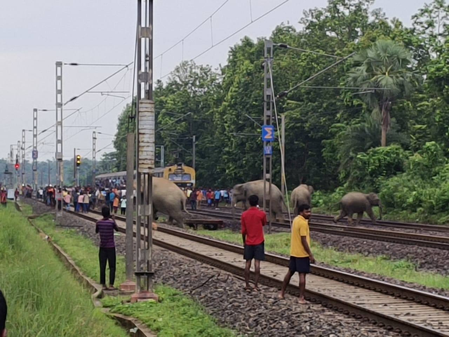
Jamshedpur: The once-crucial Elephant Corridor connecting Jharkhand’s Kolhan division with neighbouring West Bengal has now become a death trap for the very animals it was designed to protect. In the past 45 days alone, seven elephants have lost their lives within a 100-kilometre stretch—victims of speeding trains, electrocution, and even landmines.
The latest tragedy struck on the night of July 17–18, when three elephants, including two calves and an adult, were killed after being hit by the Jan Shatabdi Express near Banstola railway station in West Bengal’s Jhargram district, close to Jharkhand’s Ghatsila subdivision.
The incident occurred around 1 a.m. as the elephants were crossing the railway tracks. All three died instantly, and their mangled bodies remained on the tracks for hours, disrupting traffic along the busy Howrah-Mumbai route. The carcasses were finally removed on Friday morning using JCB machines, allowing train operations to resume.
According to forest officials, the elephant herd had been sighted in the Banstola forest area for several days. The forest department had issued warnings to railway authorities, but no action was taken to slow down the trains. On the night of the incident, villagers and forest staff were using torches to steer the elephants away from residential areas when the speeding train struck.
Jhargram Divisional Forest Officer Umar Imam stated that the tragedy could have been prevented with proper coordination and timely response. “Had the train slowed down in response to the alerts, this could have been avoided,” he said.
This incident is part of a disturbing pattern of elephant deaths in the Jharkhand-Bengal corridor. On July 10, an elephant was found dead in the Serengasia Valley in West Singhbhum, believed to have been electrocuted by live wires laid in a farm field.
Just days earlier, on July 5, a six-year-old elephant named Gadru succumbed to injuries sustained in an IED blast allegedly planted by Maoists in Saranda Forest. Despite intensive treatment efforts by the Forest Department and Gujarat-based wildlife NGO Vantara, the elephant could not be saved.
On June 24, another female elephant was electrocuted in Heaven village under Chandil Forest Range in Seraikela-Kharsawan district after coming into contact with an illegal electric fence set up by a farmer. An investigation is underway.
Earlier, on June 5, an elephant was found dead near Ambeda in the same forest area, also suspected to have been electrocuted.
These recurring deaths signal a deepening crisis in the forests of Kolhan. In the past three years alone, over 20 elephants have died in the Kolhan division due to human-induced causes. In November 2023, five elephants were electrocuted in Musabani (East Singhbhum). In July 2024, a female elephant was found dead in Bhadua village, Baharagora.
According to figures presented in Parliament, 528 elephants have died due to unnatural causes in India over the last five years. Of these, 30 deaths due to electrocution were reported in Jharkhand alone.
With inputs from IANS