

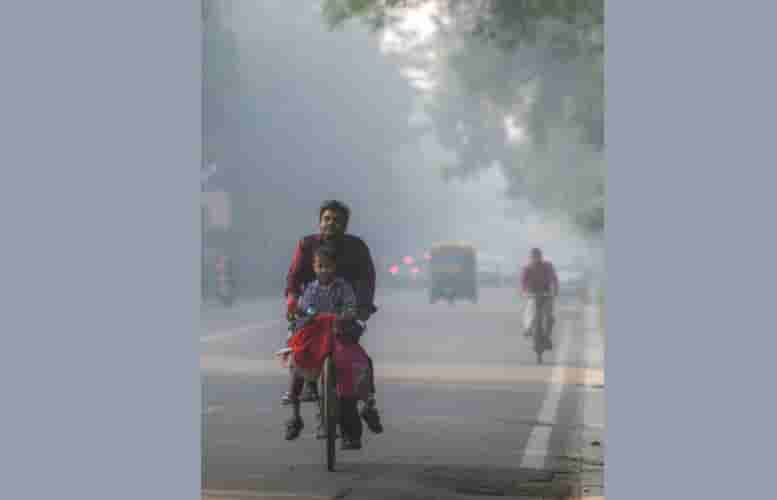
Ranchi: Air pollution in Jharkhand’s capital has worsened in the aftermath of Diwali, with several localities recording alarming levels of air pollution. The city’s Air Quality Index (AQI) has risen steadily over the past three days, reaching 193 in Sector 2 on November 9.
The deterioration comes after widespread firecracker bursting during Diwali celebrations, adding to concerns over the health risks posed by rising concentrations of fine particulate matter in the air.
Available pollution data show that Ranchi’s daily average AQI stood between 142 and 152 on November 7, placing the city in the ‘Moderate’ category. The situation worsened on November 8, when the average AQI increased to between 156 and 164.
On November 9, real-time readings at different monitoring locations showed the AQI fluctuating between 163 and 189, with some neighbourhoods recording even higher levels.
Sector 2 reported the highest AQI at 193, followed by Deepatoli at 191. Dhumsa Toli and Gandhi Nagar Colony both recorded 189, while Koker Chowk registered an AQI of 186.
PM2.5, or fine particulate matter, remains the major pollutant affecting the city’s air quality. Smoke and tiny particles released by firecrackers have contributed to the post-Diwali pollution spike. However, experts point out that several other factors are also responsible for the deterioration.
Falling temperatures and slower wind speeds during November can prevent pollutants from dispersing quickly, allowing them to remain suspended in the atmosphere for longer periods. The problem may become more pronounced during late-night and early-morning hours, when cooler conditions and limited atmospheric movement encourage fine particles to accumulate closer to the ground.
Air quality may fluctuate during the daytime as sunshine and increased atmospheric movement help disperse some pollutants.
Health experts are particularly concerned about PM2.5 because these extremely fine particles can penetrate deep into the lungs when inhaled and may cause or aggravate respiratory problems. Children, senior citizens and people with existing respiratory conditions are especially vulnerable.
Senior physician Dr Jitendra Kumar of CCL Hospital in Gandhinagar, Ranchi, has advised vulnerable people to avoid prolonged outdoor exposure during the early morning and late evening hours. He has also recommended avoiding strenuous physical activities in open areas during these periods.
While firecracker smoke is an important factor behind the recent deterioration, it would be misleading to attribute the entire rise in pollution to Diwali celebrations alone. Vehicle emissions, road dust and prevailing weather conditions also contribute significantly to Ranchi’s air pollution.
The rising AQI has once again highlighted the need for sustained pollution-control measures in the capital. Beyond festive celebrations, controlling vehicular emissions, managing construction dust and improving urban air quality monitoring will be essential to protect residents from prolonged exposure to polluted air.
-IANS