
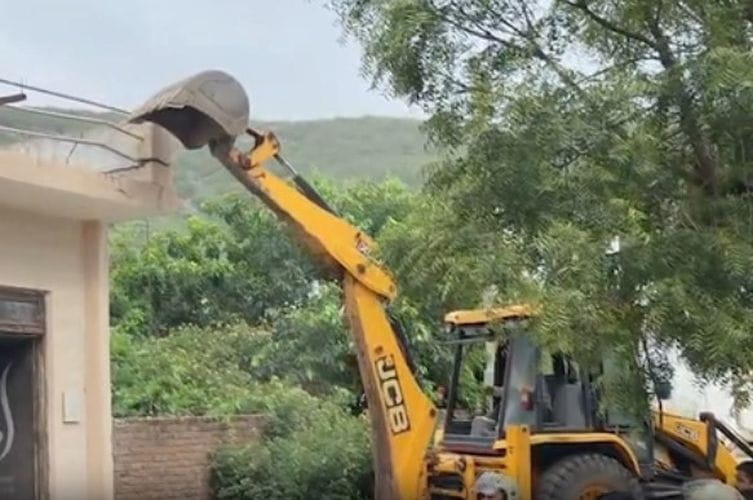
Ranchi: The Jharkhand High Court has upheld an order directing the state government to compensate a Chatra shopkeeper whose shop was demolished with a bulldozer without following due legal procedure, dealing a setback to the state administration.
A Division Bench comprising Chief Justice M.S. Sonak and Justice Rajesh Shankar dismissed the state’s appeal, observing that the demolition was carried out without legal authority and amounted to an abuse of official power.
The court directed the Deputy Commissioner of Chatra district to deposit Rs 5.25 lakh with the High Court Registry within one week. It also made the Deputy Commissioner personally responsible for ensuring compliance with the order within the stipulated period.
The compensation will be released to the shopkeeper after he submits valid proof of identity and his bank account details.
The case relates to Rajendra Prasad Sahu, also known as Rajendra Prasad Shaundik, a resident of Chatra. In a petition filed before the High Court in 2011, he alleged that the district administration had demolished his shop without issuing any prior notice or following the legal procedure prescribed for such action.
On June 27, 2024, a single-judge bench of the High Court directed the state government to pay Rs 5 lakh towards the reconstruction of the demolished shop and an additional Rs 25,000 as compensation for the mental distress caused, taking the total amount to Rs 5.25 lakh.
Although the court had ordered the payment to be made within six weeks, the government neither complied with the directive nor paid the compensation. Instead, it challenged the order before a Division Bench, while the petitioner initiated contempt proceedings over the delay.
During the hearing, the state argued that the land where the shop stood had been acquired as far back as 1914 and sought permission to place historical records before the court.
The High Court, however, noted that despite the case remaining pending for nearly 13 years, the government had never produced these documents during earlier proceedings. It ruled that introducing fresh evidence at the appellate stage was not permissible.
The Bench further observed that the documents submitted by the government did not conclusively establish that they pertained to the disputed property. It also questioned why the authorities had never challenged the land mutation, which had been carried out on the basis of a registered sale deed executed in 1973.
Finding no merit in the state’s arguments, the High Court refused to interfere with the earlier order and upheld the compensation awarded to the shopkeeper, reaffirming that the demolition had been carried out in violation of due legal process.
With inputs from IANS