
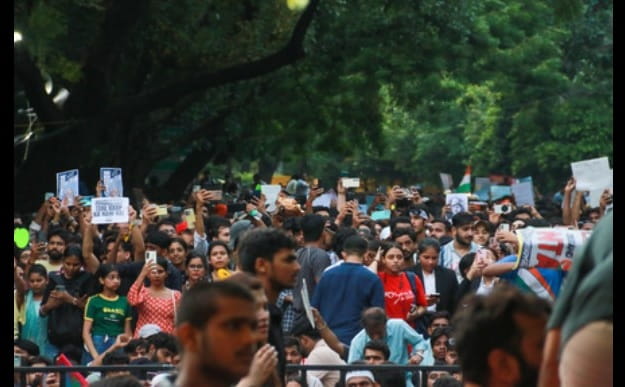
New Delhi — The Cockroach Janta Party (CJP) protests in Delhi, which began over allegations of examination paper leaks, unemployment and corruption, have transformed into a nationwide political movement, raising questions about whether the agitation reflects a broader global pattern seen in recent protest movements.
Within weeks, the campaign expanded from a focused demand for accountability in the education system into a large-scale mobilisation that eventually resulted in the resignation of Union Education Minister Dharmendra Pradhan.
The rapid growth of the movement, its strong social media presence, large participation of young people and sustained public attention have led observers to examine whether the CJP agitation is part of a wider trend of modern protest movements. While the concerns that triggered the protests remain significant issues, analysts point out that the way the campaign expanded resembles patterns witnessed in several movements across the world over the past two decades.
From Eastern Europe and the Arab Spring to more recent protests in Sri Lanka, Bangladesh and Nepal, many movements have shared common features — digital mobilisation, widespread youth participation, international media attention and the use of symbolic public spaces.
Between 2024 and 2026, major protest movements in countries such as Bangladesh, Kenya and Serbia led to significant political changes, while similar demonstrations were reported in Indonesia, Madagascar, Morocco, Nepal, Peru, the Philippines and Timor-Leste.
Analysts suggest that the CJP agitation reflects some characteristics associated with these global protest models, particularly the role of young, politically unaffiliated activists who quickly emerged as key faces of the movement.
A defining feature of several recent protests has been the limited involvement of traditional political parties during the early stages. Instead, technology-driven individuals and grassroots networks have played a major role in organising campaigns and spreading messages through digital platforms.
Social media has increasingly become the primary tool for mobilisation, while strategic locations are often chosen to maximise visibility and public participation. Many such movements begin with specific public grievances but gradually expand into broader challenges to government authority.
Although these campaigns often describe themselves as decentralised or leaderless, their coordination, messaging strategies and digital outreach have attracted attention from governments and security agencies.
The debate over such movements can be traced back to the early 2000s, particularly Serbia’s Otpor movement, which played a key role in the fall of Slobodan Milošević in 2000. The movement later became the subject of debate following reports of support and training from international democracy promotion groups.
A similar debate emerged during Ukraine’s 2004 Orange Revolution, where organisations such as Freedom House, the National Democratic Institute (NDI) and the International Republican Institute (IRI) were involved in programmes related to election monitoring and civic engagement.
Supporters of such initiatives argue that they strengthen democratic institutions, while critics claim they can influence political developments in strategically important countries. These organisations, however, have acknowledged providing training in areas such as leadership, civic participation and communication skills.
The issue gained further attention during the Arab Spring, when youth-led movements in countries including Egypt and Bahrain used digital platforms and organisational networks to coordinate protests. International organisations involved in democracy programmes said their efforts focused on promoting civic participation and non-violent activism.
A similar pattern was observed in Bangladesh, where student protests over quota reforms expanded into a wider political movement that eventually led to the removal of then Prime Minister Sheikh Hasina. Hasina had alleged foreign involvement in the unrest, though the claim remains disputed.
In Sri Lanka, the 2022 protests following the country’s economic crisis also raised questions about how a prolonged public movement was organised and sustained despite severe economic challenges.
Nepal witnessed another example of rapid mobilisation, where demonstrations that began after online campaigns quickly escalated into nationwide unrest, eventually leading to the resignation of Prime Minister K.P. Oli.
The CJP movement in India has also come under scrutiny because of its rapid expansion. The organisation gained momentum around issues related to unemployment and examination irregularities, with founder Abhijit Dipke coordinating the campaign after returning from studies in the United States.
The participation of activist Sonam Wangchuk through a prolonged hunger strike further increased national attention and gave the movement additional momentum. During the protests, allegations surfaced in some sections of the media about possible foreign funding, though no evidence has been established publicly.
Supporters of the movement have argued that it represents genuine public anger, while critics have examined whether it shares similarities with other globally witnessed protest movements.
The Opposition attempted to use the agitation for political advantage, while international media coverage placed the protests within a broader discussion on democratic institutions and public dissent.
Images of clashes between police and protesters increased attention around the movement. The scale of mobilisation, particularly as demonstrators moved towards Parliament, highlighted the challenge faced by authorities in managing rapidly expanding digital-era protests.
The central question, however, remains how genuine public grievances develop into sustained political movements capable of creating major political consequences.
While external actors cannot create dissatisfaction where none exists, analysts argue that in certain situations they can amplify existing concerns, strengthen networks and accelerate mobilisation.
With inputs from IANS