
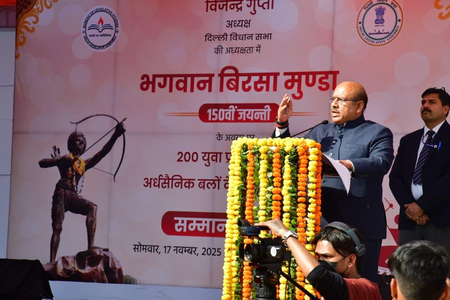
New Delhi — The Delhi Legislative Assembly on Monday marked the 150th birth anniversary of Bhagwan Birsa Munda by honouring more than 200 youths and officers from Maoist-affected districts, reaffirming a national commitment to inclusivity, environmental protection, and cultural pride.
Addressing the commemorative gathering, Assembly Speaker Vijender Gupta said the occasion was an opportunity to recommit to an India that cherishes diversity and ensures dignity for the poorest and most marginalised. He described Birsa Munda as an enduring symbol of courage whose ideals continue to shape the nation’s moral compass.
As part of the Ministry of Youth Affairs and Sports’ Mera Yuva Bharat (MY Bharat) initiative, 200 youths and 20 officers from the CRPF, BSF, and ITBP — representing eight Naxal-affected districts across Chhattisgarh, Madhya Pradesh, Jharkhand, Odisha, and Maharashtra — visited the Delhi Assembly and shared their experiences from their tour of the national capital.
The event was attended by Delhi Cabinet Minister Ashish Sood as Chief Guest, along with Deputy Speaker Mohan Singh Bisht and MLA Sanjay Goyal.
Participants expressed enthusiasm about exploring Delhi’s vibrant cultural, political, and infrastructural landscape. Many youths confidently shared their insights on stage, noting how firsthand interaction with democratic institutions broadened their perspectives and fuelled new aspirations.
Gupta highlighted that Birsa Munda’s Ulgulan movement represented not just resistance, but a disciplined campaign rooted in spiritual awakening, social upliftment, and political assertion. He noted that the Chotanagpur Tenancy Act of 1908 remains a lasting tribute to Birsa’s struggle, protecting tribal land rights, abolishing forced labour, and preserving ancestral ownership.
He emphasised that Birsa Munda’s message — safeguarding jal, jungle, zameen — serves as a reminder that genuine progress must respect both communities and the environment.
Welcoming the visiting youths and paramilitary officers, Gupta said their presence reflected a strong spirit of national unity and service. He encouraged them to draw inspiration from Birsa Munda’s values of equality, honesty, and environmental harmony as India advances toward the goal of Viksit Bharat 2047.
“Birsa Munda’s life teaches us that true leadership springs from conscience, and that our nation’s real strength lies in justice, diversity, and compassion,” he said.
Cabinet Minister Ashish Sood remarked that education becomes truly meaningful when it helps young people stay connected to their roots. He expressed pride in hosting students and officers from tribal regions, especially from Bastar and neighbouring districts.
He added that the vision of NEP 2020 — creating future-ready citizens grounded in India’s knowledge systems — can be achieved when students explore India’s cultural richness and understand their own traditions more deeply.
Deputy Speaker Mohan Singh Bisht noted that the MY Bharat initiative reflects the country’s commitment to empowering youth from conflict-hit areas. He said their presence in the Delhi Assembly symbolised hope, progress, and unity, and that such exposure would inspire them to dream big and contribute confidently to the nation’s future.
With inputs from IANS